
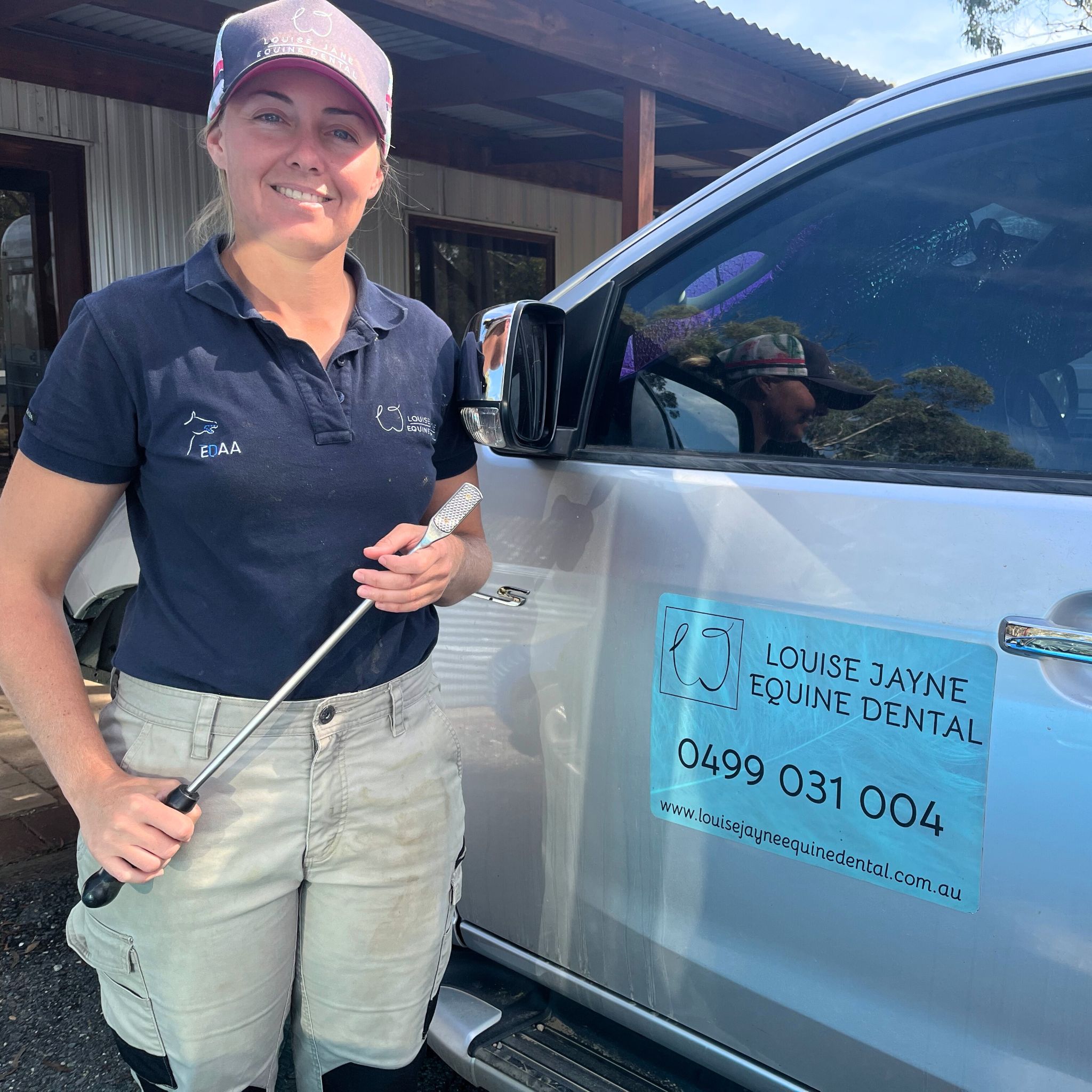
Louise Blampied doesn’t have your typical run-of-the-mill job.
She’s one of a few qualified equine dentists in Australia and makes a living keeping some long faces happy and healthy.
Equine dentistry is a relatively unknown profession outside of the horse-riding community and many people are often shocked to hear that a job dedicated to keeping a horse’s teeth in top condition is actually in high demand.
It turns out that just like people, horses need healthy teeth too!
Louise can find herself servicing the mouth of a humble pony on a Bungendore property one day and a million-dollar racehorse at Thoroughbred Park the next.
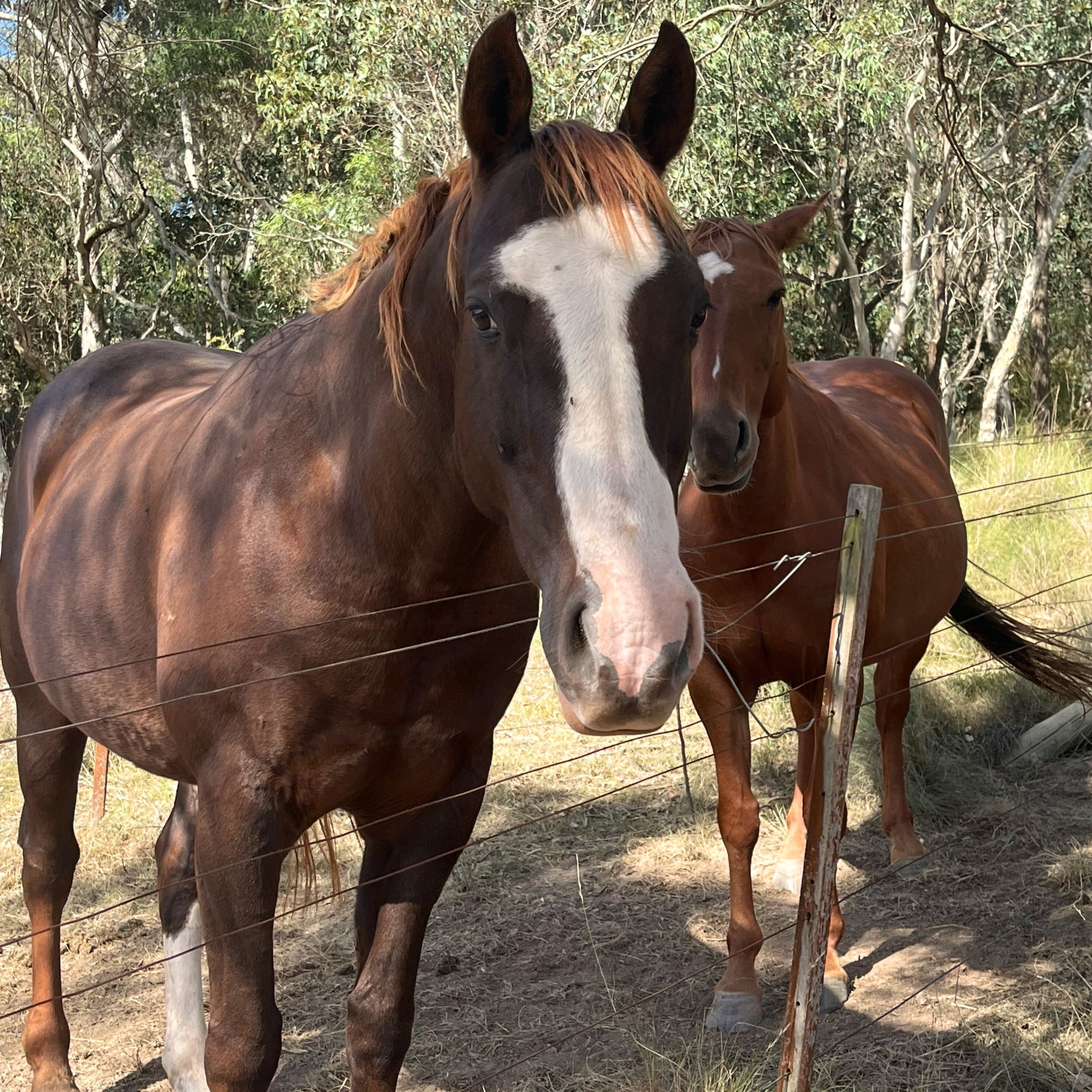
The proud owner of Ned Kelly, a beautiful 14-year-old brumby, Louise is very familiar with the unique dental issues that horses can experience.
Luckily for Ned and the hundreds of other horses she works alongside every month, Louise has just the skillset and bucket of tools to keep those pearly whites shining.
I spoke with Louise about what a typical day looks like for an equine dentist, the importance of a regular checkup and her unbridled passion (see what I did there?) for taking care of horses big and small.
Q: How did you find out that equine dentistry was a career option? What made you consider it for yourself?
A: I grew up with horses. I never had my own, but I was always around them in some capacity. I was at my local riding school every weekend; I just loved it. There was a horse at the school that became quite skinny and wouldn’t put on weight, so they had a horse dentist come out and he fixed her. That was when I first became aware of the career, so I’ve known about it for quite a while.
I had a lot of different jobs coming straight out of high school and it wasn’t until I was about 22 that I really started looking into equine dentistry as a career. It was very hard to get into the course that I did, so I didn’t actually finish until I was 28.
Q: Where did you study equine dentistry and what was that process like?
A: I did my Certificate IV in Equine Dentistry through TAFE in Tamworth, and I also did an accreditation through the Equine Dental Association of Australia (EDAA) who run their own registered course. I’ve since become a member of the EDAA and they only take two students a year so they can put all their effort into training us. It helps us learn not just the theory side of things, but we also had to undertake an 12-18 month practical course as well. It’s an unpaid apprenticeship where you go to work with other EDAA members and work 40 hours learning under them for 5-6 days a week.
Q: What kinds of issues do horses need to see a dentist for and how often should they get a check-up?
A: Dental visits for horses are something that should get done once or twice a year depending on their age or their propensity to certain genetic conditions. The reason horses need to see a dentist is to do with the mechanics around how they chew food. Their molars are at a bit of a slant, they’re not straight like ours, and because they rarely chew enough they develop enamel points that end up cutting into their cheeks and tongue. As they continue to chew in this state, they can become ulcerated and that’s where we come in to help them out.
I’ve got a file that I use to smooth out their teeth which looks a little bit like a golf club. It’s made of titanium and has serrated edges. It doesn’t hurt the horse; we do everything un-sedated and a quick file to smooth out their teeth can fix their issues right up. Horses’ teeth also weren’t designed to have bits in their mouth, which is the metal part of the bridle that goes into their mouth. When we use a bridle on a horse their teeth will also naturally come to a point when you pull on the reigns, so we also use those same titanium files to smooth out their teeth to make the bit sit more comfortably in their mouth.

Q: Besides those titanium files, what other kinds of tools do you use to treat a horse’s teeth and what do they do?
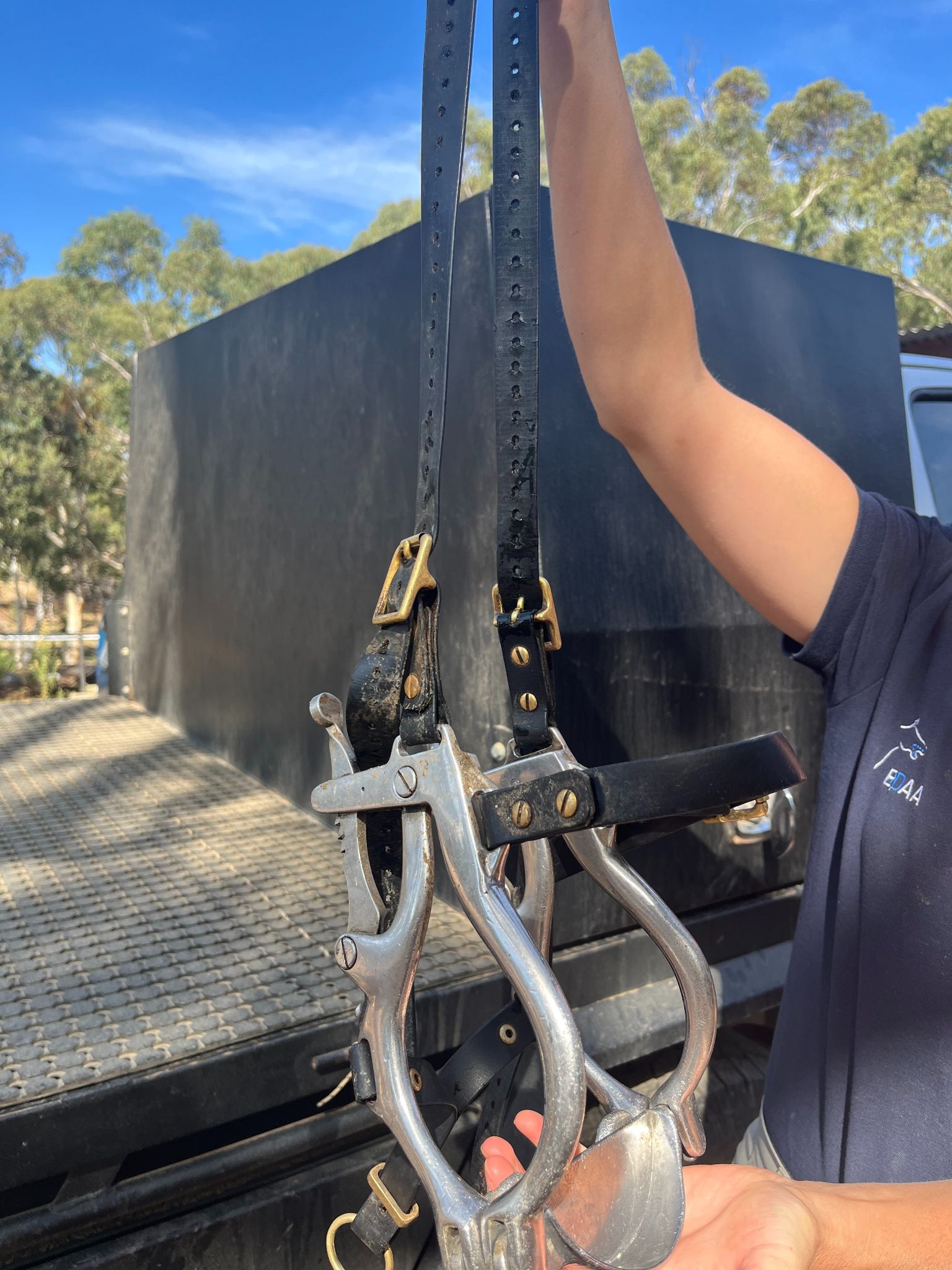
A: So, I’ve got a big bucket of tools. I’ve got five rasps that are all different angles and lengths to reach all the different parts of the horse’s mouth. These rasps hold their mouth open so I can see any issues the horse is having. I don’t wear gloves when I’m working on the horses; I do everything by feel so it’s really important that I have access to hard-to-reach spots. This can come with some issues; my hand is pretty scarred up because their teeth can be sharp and they like to bite sometimes.
I’ve also got some big forceps – if I’m working on an old horse with a loose tooth, I can basically just put in on top of the tooth and it just falls right out. Horses have baby teeth just like people, so they sometimes also need to be helped out if they have a tooth that’s wobbly or annoying them which is especially true for performance horses. Racehorses generally compete between two-and-a-half and five years old and they’re losing baby teeth for that whole period. It can be quite uncomfortable for them if it’s sticking out into their cheek and causing ulceration. You’re not going to be performing your best if you’ve got a sore tooth, so my job is to alleviate their pain.
Q: How many horses do you see every week and how long does an appointment last?
A: It varies, I’m only in my second year of practicing so it’s all over the place. This week I’m doing seventy-five horses, but other weeks I might only do two. I’d like to get a steady schedule of about fifty per week eventually.
An appointment lasts 20-30 minutes per horse and an owner generally gets me to look at all of their horses during the same day. I also look at a couple of horses a time at Thoroughbred Park and they can be pretty expensive racehorses and dressage horses.
Q: How do the horses usually react when you’re working on their teeth?
A: The horses are usually quite cooperative and don’t mind me working on their teeth. You do come across a spicy one every now and again, and I’m not going to pretend I can work on every horse. There are some horses that you just can’t get done without sedation and that’s when we would recommend the owner call a vet who is qualified to work on a horse while sedated. We’re lucky in Canberra, we’ve got some amazing dental vets. They do similar things to me in regards to filing down a horses’ teeth, but they use electric tools. My tools are basically a stick with a serrated bit on the end, but vets use electric tools so the horses definitely need to be asleep.
Q: What’s the hardest part of your job?
A: Sometimes older horses with a sore tooth can be a bit of a challenge. Some horses are really well behaved, they’ll let you work around the bad tooth and you can leave it until the last minute to pull it out. But others are just in so much pain that it’s hard to get them to settle down. Horses are stoic animals, so by the point an owner might notice something’s wrong, there’s quite a big issue. As soon as you try and touch the horse’s mouth it just freaks out. I’m busy thinking “just let me help you, if I can just get that tooth our for you, all the pain will go away”, meanwhile the horse is trying to bash me with its front feet or headbutt me with the gag. So that’s definitely the most dangerous part of the job, when an animal is in pain and its only response is fight or flight.

Q: What about wild horses? Why don’t they need their teeth filed?
A: Well, wild horses actually do need their teeth filed. It’s a bit of a misconception that brumbies don’t need their teeth treated. I’m affiliated with a lot of brumby people because I’ve got one of my own. I’ve yet to see a brumby that comes from the wild that hasn’t needed their teeth done – a lot of them are actually very ulcerated. The theory that wild horses don’t need teeth filing comes from America where they’ve got different grasses and are chewing 30,000 or more chewing strokes of hay per day, which keeps sharp points from forming. But in Australia, our native and non-native grasses that owners put their horses on are not suitable for that amount of chewing. That’s why a brumby eating wild grass in Kosciuszko is not that different from a horse in private care.
Q: What’s your favourite part of your job?
A: Besides getting to work with horses, I’d have to say working for myself and being in control of my own schedule. It has its pros and cons, but its mostly positive. There’s no sick leave or holiday pay but if I want to take a week off to go riding in the Snowy Mountains, I can. It’s really freeing to be able to work for myself.
Original photos by Sarah Grieb