
“Te Paepae Aora’i – Where the Gods Cannot be Fooled”

SaVAge K’lub, Where The Gods Cannot Be Fooled exhibited at the National Gallery of Australia from the 29th of June 2024 to the 10th of March 2025, showcasing the very best Pacifica pieces interlinked with historic works from the National Gallery itself.
After eight months on display for guests to enjoy, it was time to end the exhibition with a special closing ceremony.
The SaVĀge K’lub, is a reference to the gentlemen’s club. Established in London in 1857, the club was men’s only and quickly spread throughout the Commonwealth.
The capitalization of VA represents the Samoan notion of VA as a relational space between people and the bonds formed during the art-making process.
This show represents the intermingling of diverse backgrounds, and the creativity that can emerge from a history of pain and colonisation.
Rossana Raymond is the founding member of the new and improved SaVĀge K’lub. Her reason for its creation? “If you can’t join them, start your own.” She gives an older, outdated premise a modern-day Pacifica twist.
Rossana was joined on stage by one of the gallery’s lead curators. He thanked her for her commitment to spreading her story and heritage with the institution, as well as the audience for taking the time to attend the show.
She then spoke about one of the key pieces in the exhibition. A portrait of a Pacifica princess by James Webber. A woman named Poedua, daughter of Orio, chief of Ulietea, from the Society Islands. Who had been painted through the eyes of her Western colonisers.
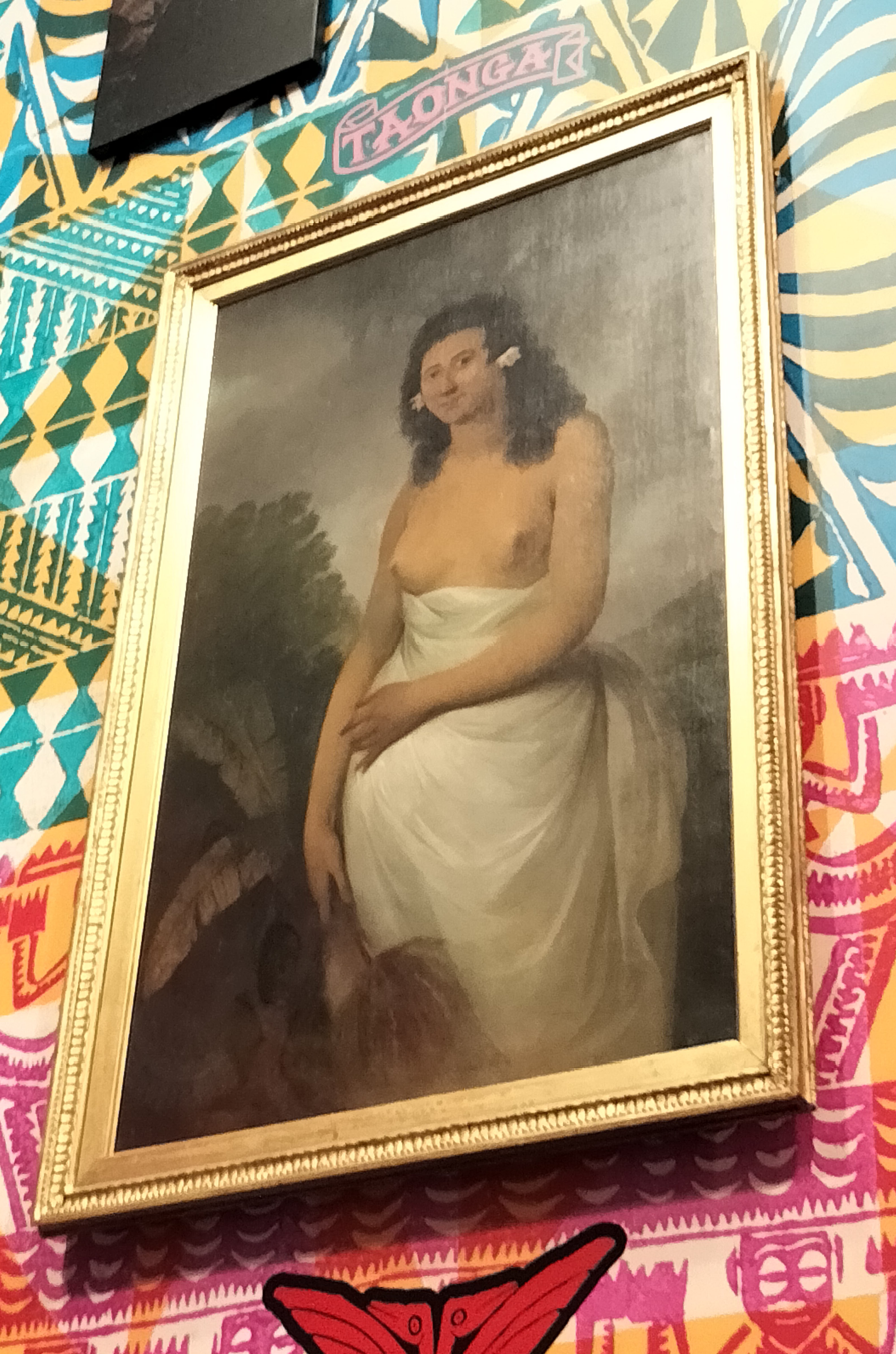
The painting represents the beginning of a new era and how the Pacifica and their ‘exotic‘ way of life caused their people to be essentially misrepresented. In the portrait, she is depicted with her natural hair, a storm behind her, and an exposed bosom. She is on display for the West to enjoy unapologetically. The narrative the portrait creates underlines the suppression and silencing of a people.

Across from this portrait, with a corresponding theme, hung another piece. A Māori woman, standing tall, dressed in a Union Jack. Though elements of the West are present, she stands more defiantly than her predecessor.
The event included multiple performances from the Tumanako Māori Culture Group, displaying key values of resilience and community.
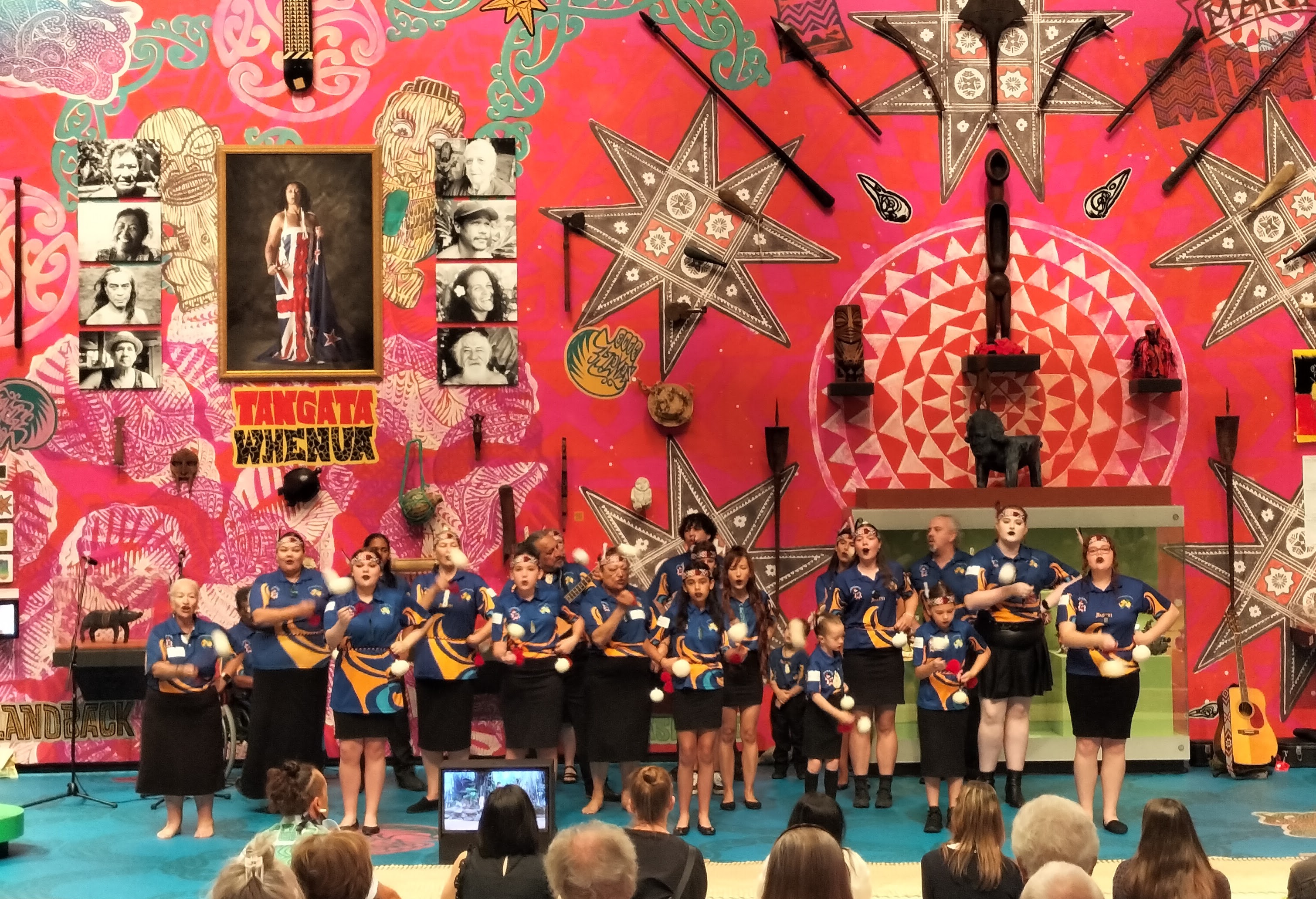
They have travelled internationally, performing songs of their culture. The groups consist of members of all ages. Kids as young as five were seen doing a battle cry with all their might. They don’t all belong to the Māori heritage, which brings a sense of diversity that makes the team thrive.
Their voices could be heard throughout the gallery, strongly making their presence known. The singing changed from retellings of a difficult history to gentle renditions on themes of love and celebration.
Once the Tumanako Māori Culture Group finished their final performance, artist Sālvādor Brown proudly thanked them with his own battle cry before sharing his insights.
Plenty more of the artists were also in attendance, there to provide an explanation of their works to a keen audience.
They held numerous workshops, and during performances, visitors were encouraged to remove their shoes and sit on a mat in the centre of the room to further connect with the show.
I had the chance to speak with Numangatini Mackenzie, who felt so passionate about the role his art played. He was responsible for the prints featured on the walls and has been a hardcore member of the SaVĀge K’lub for the past ten years.
His work first presented itself in the form of street art before he reconnected with his Maori heritage. He now enjoys the process of carving wood blocks to use in his prints before enlarging them. It creates a mesmerizing gallery space that really captivates the viewer.
Workshops included the chance to learn how to print your own SaVĀge K’lub T-shirt with Numangatini and an artist talk with Ruth Woodbury. Who was also teaching how to make your own earrings, necklace or hair accessory.
Artist Francesca Contaldo held a ‘Making Your Mark’ workshop that explored Tattoo art and how her other skills of painting and pottery are used to honour her ancestral forms of creation.
Overall, it was a shame that the exhibition was coming to an end. But its message will continue to spread as long as Rosanna Raymond continues carrying the values and soul of her SaVĀge K’lub. Sharing her beautiful culture with the masses.
In the meantime, the National Gallery always has a new show coming around the corner.
Photos by Yasmine Killeen