

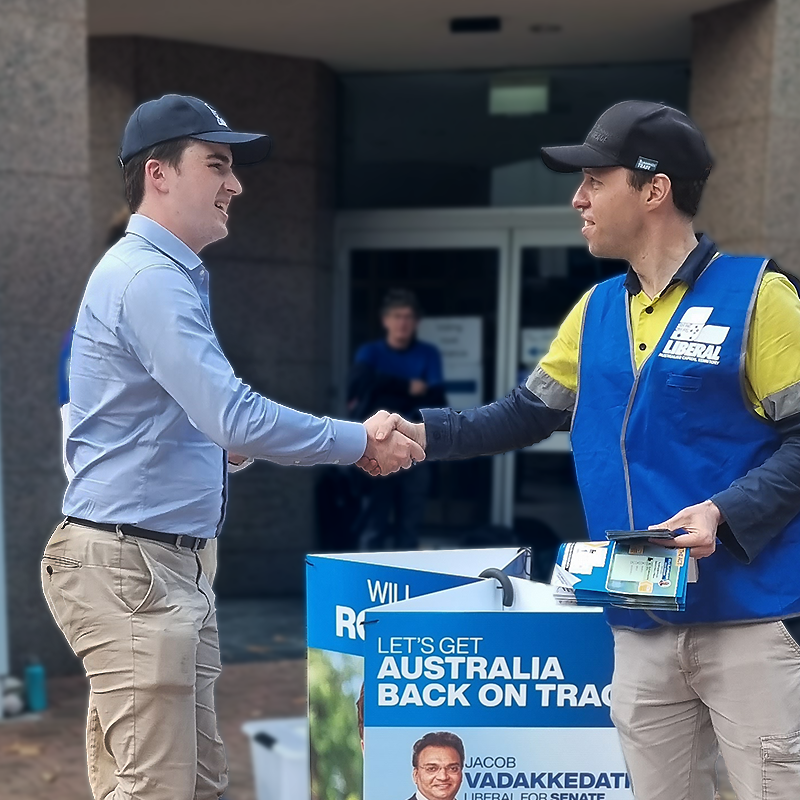
At just nineteen-years-old, Will Roche is running as the Liberal Party’s candidate for the seat of Canberra.
If elected, he would become the youngest MP in Australian history, surpassing Wyatt Roy’s record by a year.
With a passion for his hometown and a desire to improve his community, he stepped into the world of Australian politics with one clear goal: giving a voice to young Canberrans.
Will believes his awareness of issues affecting young people makes him an effective candidate. He points to issues like the housing crisis, the soaring cost of living and rising energy bills as major reasons behind his decision to run.
It’s these concerns that have shaped the direction of his campaign.
Will’s bid for the seat of Canberra has gained attention, not just because of his age, but because of its unapologetically local focus and his vision to revitalise his city.
I sat down with Will to discuss his motivations, what sets him apart from the crowd, and why he believes young Australians can no longer stay silent.
Q: Tell me a bit about yourself as a person to separate yourself from the politician.
A: I was born here in 2005. I’ve lived here for most of my life, and the other part I spent overseas due to my mum’s job. That means I’ve done a lot of travelling and gained different perspectives, but I’m a Canberran at heart.
Q: Where did you live overseas?
A: I’ve lived in a few countries. I spent about three years in Croatia when I was little, then about four years in New York, which was nice. And I also lived for about a year and a half in Hanoi, Vietnam. But all of those places, I think, pale in comparison to Canberra. There’s something about it—it’s home to me.
Q: Politics is typically seen as an older person’s game. Why did you decide to get into it at such a young age?
A: I think it’s important that young people involve themselves in how the country runs, purely because they are also subjects of the country. We work, we pay taxes, and we have opinions to contribute to policy debates. I think it’s really important that young people realise they’re not just kids—they have a genuine role to play in our democracy.
Q: You told me earlier that you’re studying International Relations. How has that shaped your perspective on politics?
A: International Relations is a really interesting course because it lets you understand how countries interact. When it comes to Australian politics, it’s given me a sense of how lucky we are to have such a strong and robust democracy. I think we need to make the most of that by participating and getting involved where we can.
Q: Why do you think young Australians are so disengaged from politics, and how can we improve on that?
A: At the moment, I think it’s a question of their interests not being as strongly represented as they should be. For example, the youngest member of the House of Representatives is 35. So when a young person sees a 35-year-old trying to speak on behalf of a 20 or 25-year-old, there’s a big discrepancy in experience. A lot of young people don’t relate to that, and so they become disillusioned with our democracy.
Q: Have you faced scepticism because of your age on the campaign trail?
A: Yeah, certainly. There’s concern that I don’t have much experience when it comes to jobs or working. But I think just because I don’t have the same experience as someone older, doesn’t mean I don’t have something valuable to contribute when it comes to shaping policy and improving the lives of our fellow citizens.
Q: What advantages do you think you have over older candidates, as a younger person?
A: When it comes to future-focused issues—like housing, for example—I think I have a real leg up. I’m part of the generation trying to buy our first homes, so I can speak on behalf of that group and advocate for strong, future-oriented housing policy.
Q: What policies would help address the current housing crisis?
A: I think it requires input from a variety of perspectives. One thing the Liberal Party is doing in Canberra is trying to simplify the building codes. I’ve spoken to constituents—especially builders and those in construction—and they’ve told me the current codes are strict and finicky, and sometimes don’t even achieve their intended goals. Simplifying them would allow builders to construct more homes at a lower cost.
In addition, I think curbing union militancy on job sites is important. The CFMEU’s influence can drive up costs by up to 30%, which is ridiculous for young people who just want to be able to afford a home. The coalition’s plans to de-register the CFMEU and reinstate the building and construction watchdog will have a big impact on affordability.
Q: Some university students I’ve spoken to say the Liberal Party is out of touch with young voters. How do you respond to that?
A: I don’t think it’s a case of the Liberal Party being out of touch. I think young people might just not be fully aware of the party’s policies—for example, measures to increase housing supply or reduce the cost of first-home ownership. If the party were truly out of touch, I certainly wouldn’t be here as a candidate!
Q: You mentioned awareness—do you plan on using social media to engage with voters?
A: Social media is crucial. It allows for two-way communication between me and constituents, which is really important. I want to listen to and represent the concerns of people in Canberra, and social media helps me do that at scale.
Q: What does Canberra do really well, and what areas need improvement?
A: I think Canberra does really well in being an educated and aspirational city, and the Liberal Party really reflects that aspirational spirit.
But we need to improve in areas like education and healthcare. We have some of the lowest bulk billing rates in Australia, and doctors are leaving the city. Despite having strong investment in schools, our students aren’t performing as well as they should on benchmarks, like NAPLAN. I think these are areas the territorial government needs to address, and I hope to work with them if elected.
Q: What sort of public response have you received so far on the campaign trail?
A: It’s been really positive. Lots of people are happy to see a young person having a go. I think there’s a real appetite for new voices and perspectives in Parliament.
Q: What does success look like for you, beyond just winning the seat?
A: I think a lot of Canberrans right now don’t feel listened to. Part of my mission is to make sure their concerns are being heard by the federal government, and that our local issues are getting the spotlight they deserve.
Q: What do you wish young Australians knew about politics that they might not know?
A: It’s very, very accessible. I encourage young people to get involved. It can be as simple as sending an email to your local party branch and joining up. That gives you a real say in party policy and decision-making. We’re part of one of the strongest democracies in the world, so why not take part in it?
Q: And finally, what’s your message to any voters out there you’d like to reach?
A: I’m here, and I’m listening. So send me an email, give me a call and see what I can do for you!

Original photos by Caleb Wheeler