

At the age of six, I was introduced to the amazing world of video games through Rocksteady Studio’s 2009 “Batman: Arkham Asylum.”
17 years later, I am still continuously drawn back to this title when all else fails. While you would assume this is purely nostalgia-driven, Arkham Asylum still holds its own in today’s vast gaming environment.
At its release, Arkham Asylum revolutionised superhero games due to its high-level production, transforming the playing experience for audiences and ultimately setting a new benchmark for future titles.
This high standard has since been surpassed by very few superhero titles, demonstrating Arkham Asylum’s continuous relevance for new gamers.
When I first tackled The Joker’s antics in 2009, I was sitting in front of my Xbox 360, which has since gathered dust and only reveals the red ring of death when I try to power it up.
However, the game’s re-release in 2016 as a part of the “Batman: Return to Arkham” series allows gamers to experience the game for all its glory on more recent console generations.
This has undoubtedly prolonged the relevance of Arkham Asylum, an opportunity that not every game receives. But not every game warrants a renewal of life.

Story
With an introductory cutscene that features both Batman’s capture of his archenemy, The Joker and his immediate escape within Arkham’s high security asylum, gamers are immediately thrust into a storyline that leaves many questions to be answered.
While I’ve sat through this a thousand times before, my jaw never fails to hit the floor as I’ve been set up for another long night within the Asylum.
The gothic and harrowing vibe set in the cinematic introduction makes a seamless transition into Arkham’s gameplay. Something that is effectively aided by the game’s map and character design.
Visual and audio design
Arkham Island’s design begs for exploration, and is a map that tells a million tales on its own. It isn’t too big like its successors; I can easily navigate between objectives, and there isn’t a constant flow of repetitive interactions that slow you down in between.
An issue I have with more recent titles is the excessive amounts of filler content that start to feel like a chore more than anything else.
There are some areas of Arkham that I fear returning to because of the unique character design in each of the three major areas. The lunatics, for example, raise my heart beat to unhealthy levels, as I anxiously wait to hear the harrowing screams as one tries to attack from behind.
Combat mechanics
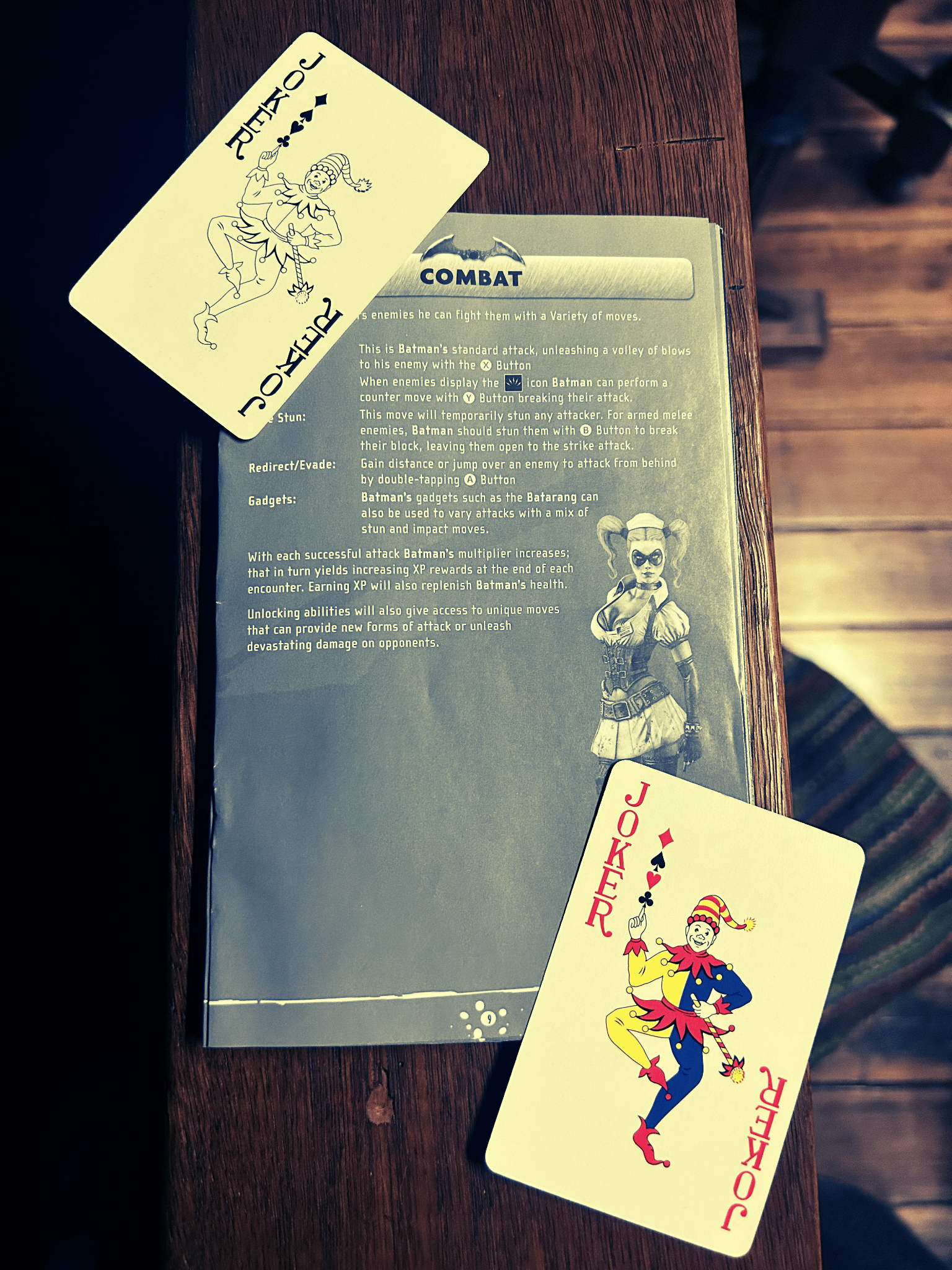
Despite revolutionising the gaming landscape for being one of the first Triple A superhero productions, it is the free-flowing combat system introduced by Arkham Asylum that assures the title’s relevance, even after 17 years.
The combative interactions feel like a cinematic experience, as I elegantly glide and leap from one enemy to another, while beautifully enrapturing the surrounding landscapes.
The mechanics themselves are very approachable. I even felt like a badass when I was six-years-old, playing it for the first time.
For the most part, combat is executed using two buttons with a few simple combinations in between. However, this is anything but a button masher.
Arkham relies on precise timing and patience while bashing an army of goons, something that has since been overcomplicated by other games.
Recent titles have leaned on the use of multiple weapons in the same encounters, which can feel bloated and less rewarding.
I am still waiting to feel as fulfilled by a game as I am watching the combat multiplier continue to rise, as I bash Joker’s goons without being struck in between each click of the button.
Shortcomings
While the character design of Arkham’s villains is artistically noteworthy, they lack variation in combative interactions.
Out of the handful of major boss fights, four encounters are almost identical. They lack any variability in the attacks they throw at you, and this becomes very repetitive.
This is something more recent titles have improved upon, even the latter two games in the Arkham series itself.
Another element of Arkham’s gameplay that doesn’t hold up today is the continuous backtracking for Riddler trophies.
This collectible journey feels like non-essential content padding, particularly as a lot of the trophies are not accessible until the final phases of the game.
My most recent play-through was the first time I had managed to achieve all of the Riddler’s challenges. Unfortunately, I didn’t feel as though it added anything positive or rewarding to my experience.
Final thoughts
Whether you approach Arkham Asylum on the Xbox 360, PlayStation 4, or get it up and running on the newest generation, you’re sure to leave the experience with a renewed expectation of superhero games.
Rocksteady provided a framework for what a superhero game should look like, and 17 years on, it is still a benchmark.
It is a title that should be in the library for all flavours of video gamers, with its approachability and groundbreaking mechanics.
In another 17 years, who knows, I may have played it on another three consoles.
Photos by Reuben Mudge