

Allister Mills is a man with a curious mind.
Since 2022 he has put that mind to work as the Curatorial Coordinator at the National Library of Australia (NLA).
Last year he played a leading role in establishing Remembering the War, an exhibition commemorating 80 years since the Second World War. The exhibition has run since August 2025. It takes a look at the human stories of WWII going past the politics and fighting that dominant modern dialogue.
I got the chance to sit down with Allister. We discussed the exhibition and what it meant to him, as well as his path to becoming a curator and the importance of exhibitions at the NLA.
Q: Can you give a background of the Remembering the War exhibition?
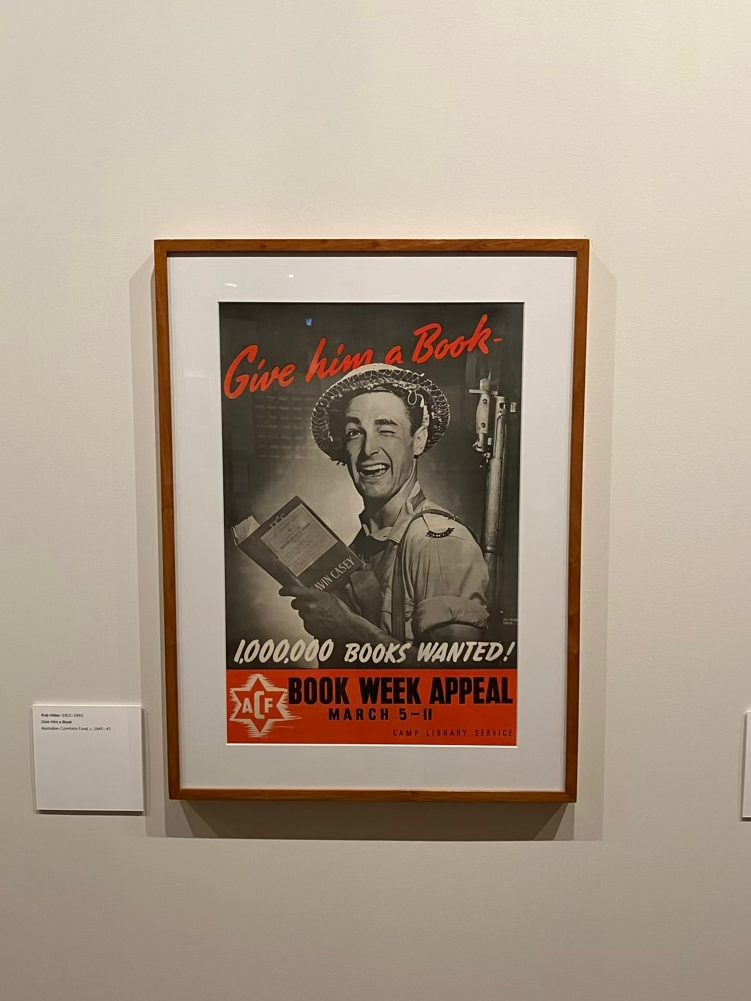
A: Remembering the War really looks at objects from the Library’s collection in kind of two categories. We’ve got quite a large collection of posters relating to the Second World War. They’re displayed on the walls with a relatively low amount of interpretation around them.
The second part of the exhibition is kind of the manuscript material, the archival material that appears in the showcases, or the showcase now in the middle of the exhibition space.
That’s a bit more of a deep dive into some of the collections that the Library holds, specifically about the role of women’s work during the Second World War, and some individual collections based around Muriel Knox Doherty’s experiences in Reconstruction-era Poland, and Stefan Swirski’s experiences in Nazi concentration camps.

Q: What do you think makes the exhibition so important, so valuable?
A: I think from an organisational standpoint, it’s really important to share these collections with our audiences to remind them that the War Memorial isn’t necessarily the only organisation which holds records relating to Australians during wartime; and that the National Library is a place for that research as well.
What we aim to do with almost all of our exhibitions is to invite our audiences from the galleries into the reading rooms, and to show them what objects are available to them.
The collection is a national collection, it belongs to all Australians.
As a result, all of the material that you find on displays in our galleries, they’re accessible via the reading rooms.
Museum catalogues are opaque to all but the most seasoned researchers, and there are other organisations which won’t let you access collection material that isn’t on display at all, unless you have a quote-unquote “valid reason” to access to it.
Q: What’s the process of setting up and maintaining an exhibition of this scale?
A: This is a relatively small exhibition, there’s only about 30 or so objects.
This show came from the anniversary of the end of the Second World War. We started there, and I worked with two of my colleagues, the former Director of Exhibitions, Dr Guy Hansen, who’s just retired, and Assistant Director of Exhibitions, Peter Appleton, to survey the collection and try and find objects that spoke to a theme around the ending of the Second World War.
In the first instance, we had hoped that the show might focus on war correspondents and their role in the Second World War, but when we came to start looking at those collections, it became clear that there was going to be a real challenge in the way that we displayed that material.

There’s real difficulty in getting people to stand in front of an object that’s primarily text-based.
I spent a lot of my career working with archival material in museums and galleries, trying to figure out how to get people to engage with the written word in exhibition contexts, both here and at the War Memorial as the curator of private records.
Especially today, there’s a real disconnect in how people wrote or learned to write in the 20th century and how people learn to write now, unless you’ve spent a lot of time reading handwriting from the First and Second World Wars it can be really challenging to actually read what it is that’s on the page, because it just isn’t taught very broadly anymore.
People with a background in archival research have had that level of experience, but given that we’re trying to attract new audiences into the reading room, we can’t assume that they’ll have that experience in reading 20th century writing. So there’s a real challenge in displaying a text, getting people to engage with it, as well as the resources that we have to display wall showcases. We’ve got a finite number of those that we can use.
We moved away from war correspondence quite quickly, but did still want to use some of that manuscript material that we had dug up, not necessarily relating to war correspondence.
The process is to find the material that we think is quite impactful.
After we’ve selected material, we’re working with our collection care team to make sure that the material that we’ve selected can be on display for the duration of the show. There are some instances where objects can’t be displayed because there’s a high risk that certain inks will fade.
We’re liaising with designers and preparators to lay the objects out, both theoretically within the space and then to physically hang them on walls. Then we’ll go in again with our collection care team and arrange the objects in the showcase.
Q: Do you have any personal connection to the collection or World War II?
A: A very, very minor one. I did go back and do some more research into my own family history.
My maternal grandmother served with the Coastal Artillery, Australian Women’s Army Service, where she was in a fire control team.
I guess the other more personal connection is the stories that people come and tell me about the war.
I gave a talk to the Friends of the National Library in the space, and a number of the women there had either served in the Royal Australian Air Force themselves or had relatives who served in the women’s services during the Second World War, who were really grateful for the service.
Q: What was your path into being a curator, and what makes being a curator the career for you?
A: My undergraduate degree was in archaeology, and as a part of that, I was volunteering at the Melbourne Museum for a couple of years.
I moved to Canberra after that, and found that there wasn’t an enormous amount of archaeology going on for people who weren’t already attached to the ANU, but had thoroughly enjoyed working in museums before that.
I went and did a Masters in Museum and Heritage Studies, and was very fortunate that not long after I graduated, the War Memorial was looking for an assistant curator.

I happened to be the right person, in the right place, at the right time, I got really lucky.
It’s a job that lends itself to those who are curious. There’s a real desire to find out things and to learn more, that curatorship lends itself to.
If we were to curate shows without deadlines, then we’d just keep going down different rabbit holes forever.
I think it’s a job that brings me a lot of pleasure in that regard, there’s always something different, and we spend a lot of time becoming, not necessarily subject matter experts, but knowledgeable on such a broad range of topics, that it really does lend itself to curious minds.
Original photos by Tobias Ostini