
By Ben Devlin, Azzie de Haviland, and Caleb Wheeler
Our changing world has put public transport in the spotlight for cities concerned about sustainability and population growth. These concerns contrast with Canberra’s own history and reputation as a city built on car travel.
59% of Canberrans drove themselves to work in 2021 compared to an average of 48% in Australia’s other capital cities. But with the development of light rail and MyWay+, Canberra’s transport system is also looking to change with the times.
Here’s what three other cities are doing to their public transport systems, and what we might learn for ourselves.
Sydney: On-demand Public Transport
Comparable to ride share services such as Uber, on-demand services allow for flexibility, letting passenger preferences determine timing, pick up location and route.
On-demand public transport services currently operate in Sydney and certain regional areas in New South Wales. It aims to connect popular destinations and transport hubs such as hospitals and shopping centers.

One on-demand service even connects Batemans Bay to Canberra with pick-up and drop-off zones in Bungendore, Braidwood and Nelligen.
Transport Canberra currently offers a limited version of on-demand public transport, referred to as the Flexible Bus Service. The service is available to Canberrans with additional needs, including older people and people with disability.
But widely available on-demand public transport has certainly been envisioned for Canberra in the past.
In 2015, the CSIRO’s digital research unit, Data61, proposed ‘BusPlus’. The goal of this system was to improve public transport services during off-peak hours using a ‘hub and shuttle system’.
Passengers would first call a taxi to ‘shuttle’ them to a nearby transport hub. Once arrived, they could board a high-frequency bus service to other hubs around Canberra.
The project aimed to have passengers onboard a bus within 10-20 minutes of their initial call. All legs of the journey would have also been included under one ticket.
Amy Jelacic, Chair of the Public Transport Association for Canberra (PTCBR), has some concern about the realities of introducing on-demand Public Transport.
It can be a good solution in some very specific circumstances, but it simply doesn’t scale very well […] it’s just not considered a great system by most […] serious thinkers about public transport
Canberra (1970s): frequent services and timed transfers
Wait times are a major factor determining public transport user satisfaction.
Strategies that improve wait times, including higher frequency services and timed transfers, were previously a reality for Canberra in the ’70s.
Following Gough Whitlam’s election win in 1972, the Federal government moved to shift Canberra’s transport priorities.
Through the following years, new policy and greater investment in public transport allowed per capita bus trips to double and car ownership to stagnate.
During this period, a timed transfer system ensured 5-minute transfers between high demand routes and local services.
Timed transfers meant less waiting for passengers who weren’t provided direct routes to their destination, an situation common for those traveling in low-density areas.
Higher bus frequency also meant, at peak periods, busier routes ran every 8 minutes and local routes ran every 15 minutes. In comparison, rapid buses currently appear every 15 minutes at their peak.


Professor Graham Currie, Public Transport Researcher at Monash University, believes that frequency is important for public transport usage.
There are three key things that improve usage of public transport. The first is frequency of service, the 2nd is frequency of service and the third is frequency of service.
In subsequent decades, Canberra has returned to its car-centric roots. Professor Currie acknowledges that Canberra’s urban development profile makes frequency harder to achieve.
‘Land use isn’t helping you and as a result the service levels are lower and that makes it hard to provide a quality network’
Higher frequency services and timed transfers happen to be featured in PTCBR’s 5 point plan for improving public transport in Canberra.
Responding to current wait times, ACT Labor promised at last year’s election to run local bus services every 20 minutes during the week by 2028.
New Delhi: transit-oriented development
Densification around existing transport infrastructure is a strategy which encourages people to live and work close to public transport nodes such as light rail and bus stations.
This transit-oriented development comes with precedent. In New Delhi, the construction of high-density developments surrounding metro stations has boosted public transport usage.
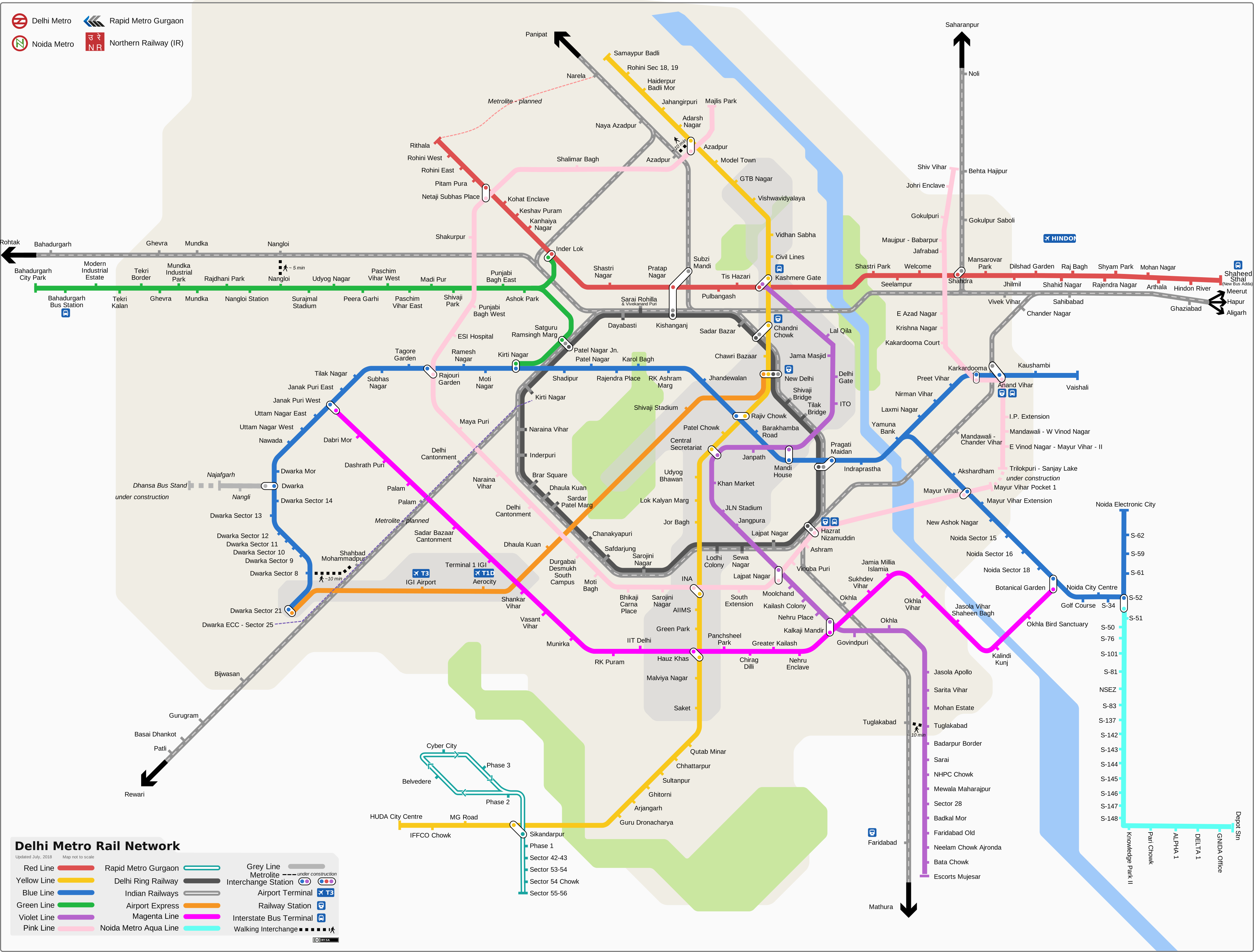

Despite inital bureaucratic obstacles, the New Delhi model has increased ridership, as well as recaptured land value, allowing reinvestment into new lines.
A similar style of coordination between developers and Transport Canberra could make our public transport system more financially viable, and more widely adopted.
Criticism has also been leveled against transit-oriented development with some labeling it as a potential source of gentrification and displacement for low-income groups.
Back in Canberra, Professor Currie regards densification as an important step in bolstering the quality of our public transport.
I think the future of cities like this is to start densifying in key corridors, which might help justify high quality public transport.
The ACT Government has already decided to take this approach, regarding Transport Oriented Development as a priority for the city.
More housing along public transport corridors will create a better-connected, accessible and sustainable city.
This approach is specifically relevant to the Northbourne Avenue’s light rail route, as well as transport hubs such as the Dickson Interchange.
By densifying, there is also opportunity for more people to access day-to-day services within walking distance, reducing Canberra’s dependency on cars.