
Have you ever pressed play on Spotify, sat down, listened to the music for bit and thought, ‘man, this would be so much cooler if it was dark and there were hundreds of candles surrounding me’?
Probably not, but I can confirm that it is actually way cooler than you would think.
Candlelight Concerts, an event by Fever, does exactly this, and honestly it’s a fantastic way to spend a cold, dark Thursday night.
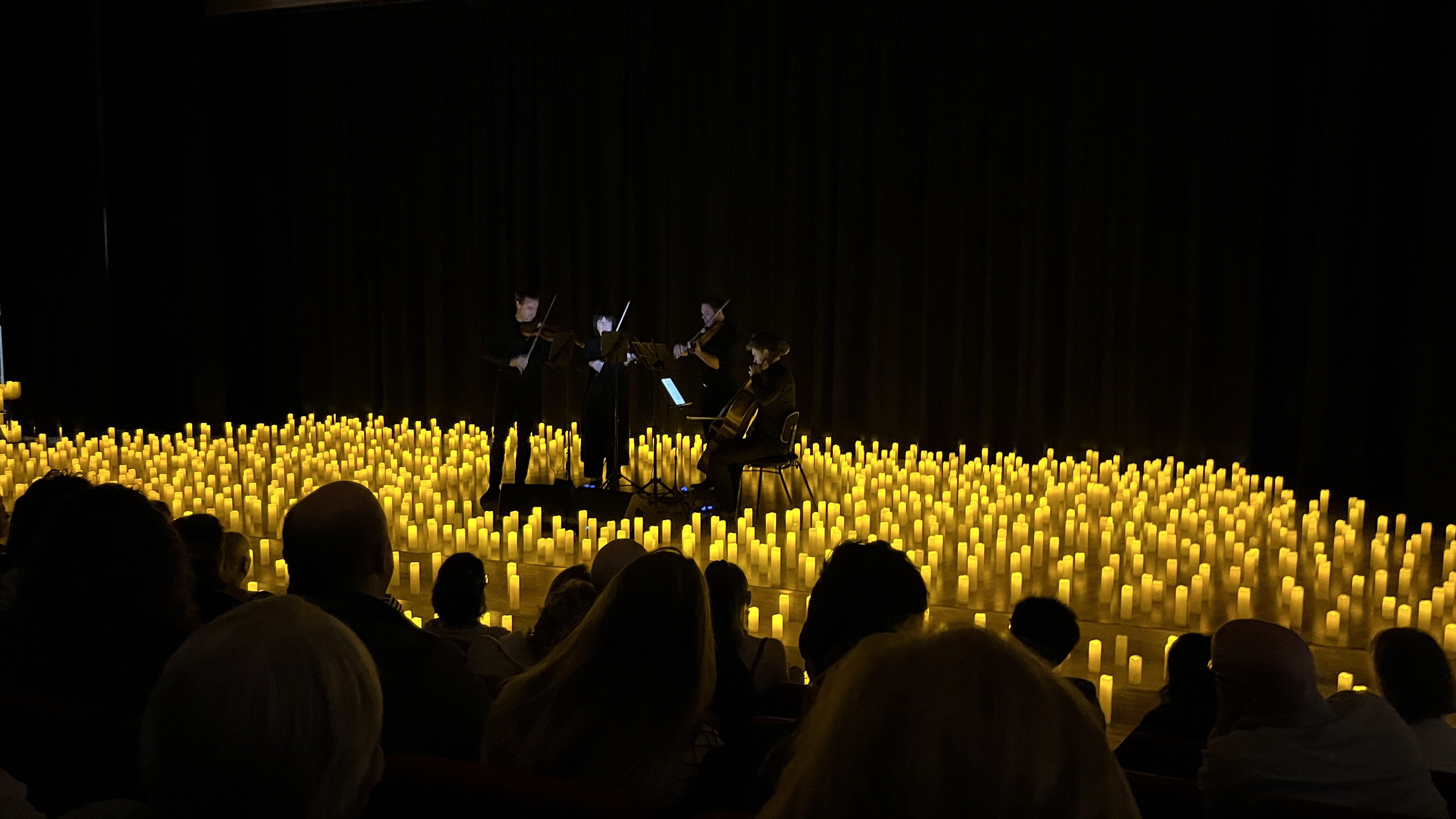
From classical music like Beethoven and Vivaldi, to covers of Taylor Swift and Queen, your senses will be enthralled by the sheer sight of hundreds of candles surrounding a four-person string ensemble, their instruments singing out covers of your favourite pieces. In warm, intimate locations across Canberra, Concerts by Candlelight delivers a multi-sensory experience that you won’t forget anytime soon.
I had the opportunity to see Phoenix Collective, a Canberra based group made up of two violins, a viola and a cello. For my show, they played a rendition of Vivaldi’s The Four Seasons at James Fairfax Theatre at the National Gallery of Australia.

The Venue
James Fairfax Theatre, National Gallery of Australia
Walking into the National Gallery after dark, my senses were already anticipating the beauty of what I was about to see. The walkways were lined with candlelight and the rest of the gallery was completely dark, silent, and shut down. There was an air to the venue that I hadn’t experienced before – peaceful and closed off but beautiful and exciting at the same time.
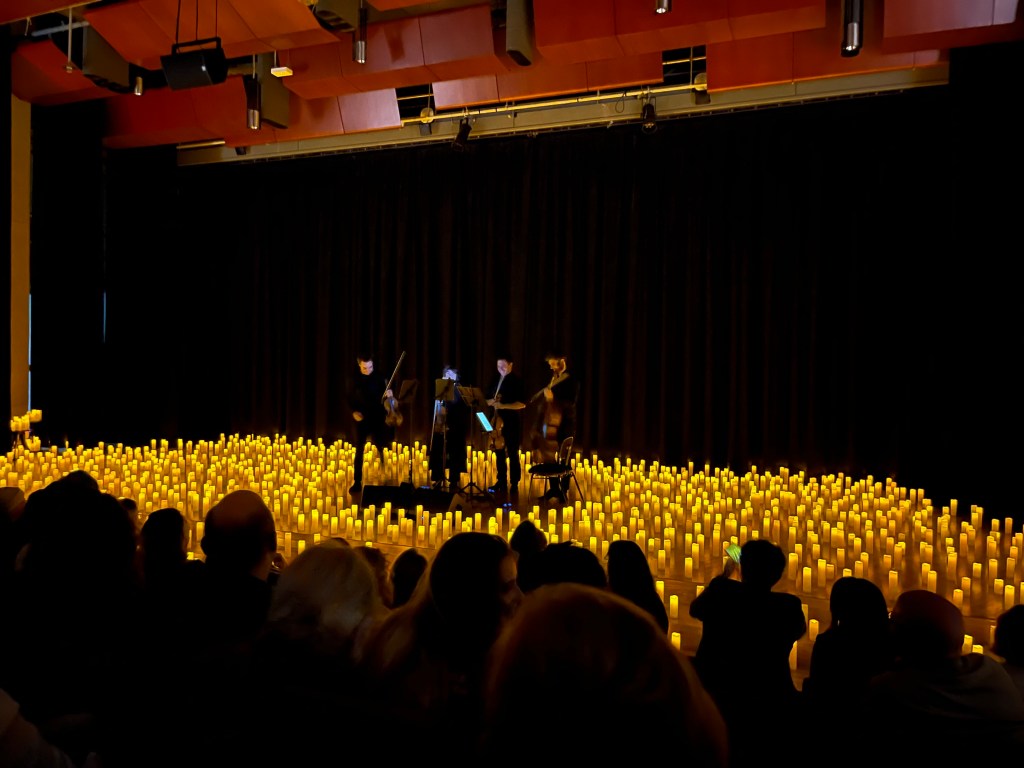
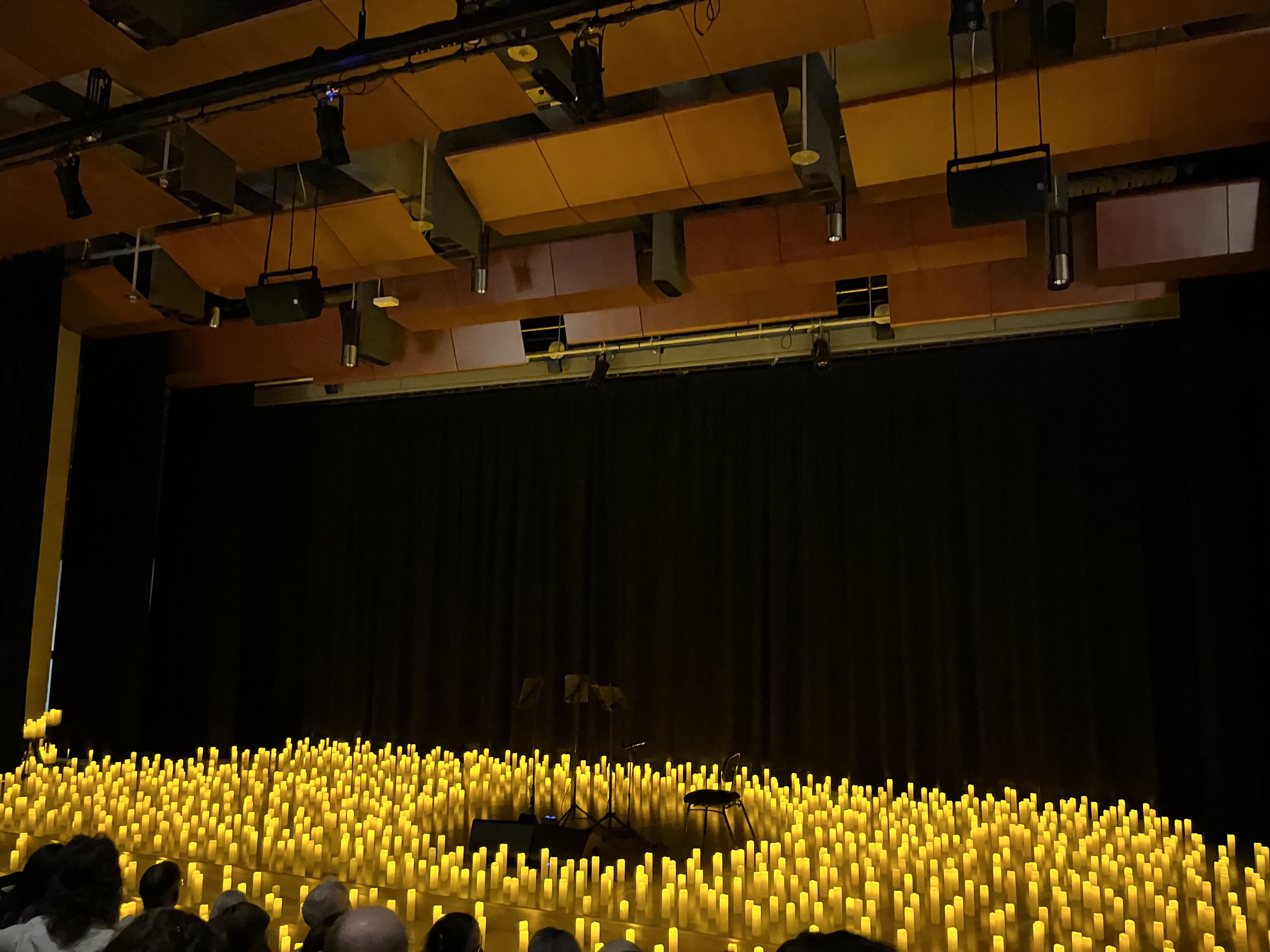
The ambience – Walking into the theatre, your eyes are immediately met with an abundance of soft, yellow specks of light everywhere – and I mean everywhere. There were candles in the walkways, the seats, the stage, and the entrance. The glow from the artificial flames was enough that there wasn’t a single light on in the venue; it was magical.
The theatre – James Fairfax Theatre is one of the smaller theatres in Canberra, with the 10 or so rows of seats filing all the way down to the edge of the stage. If you were front row you would be sitting amongst the candles with the performers.
The view – But a few rows back, I was able to see the entire stage. Though it might seem obvious, the candles are all fake, and the room isn’t boiling hot because there aren’t really 600 tiny flames strewn throughout. Unsurprisingly, that would probably be a fire hazard.
The seating – I was ushered to my section and was then able to choose my own seat in that area, giving me a chance to decide where the best seats would be to view the performance.

The History
Vivaldi’s The Four Seasons
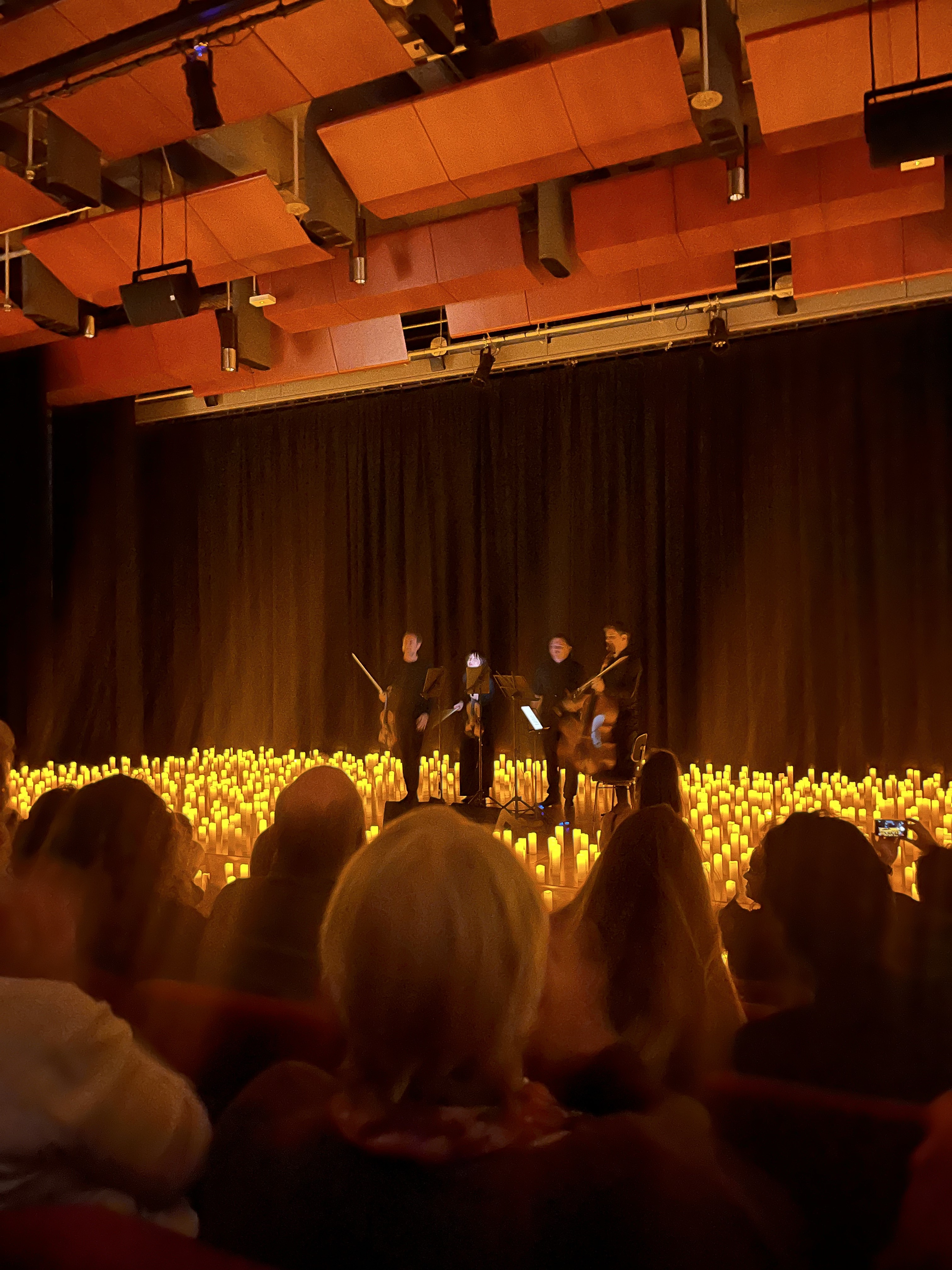
As the show was about to begin Phoenix Collective expertly walked through the candles to the centre of the stage, where they took their place amongst the candlelight. Dressed all in black, they almost disappeared amongst the yellow light.
As a classical music nerd, I was expecting music and only music. Once they walked on stage, I assumed that would be it, they would begin playing and for the next hour I could relax and settle into the show.
Much to my surprise, the show was filled with comedy, poetry, and history.
Vivaldi’s The Four Seasons is one of the most popular and well-known pieces of Baroque music to this day. However, this doesn’t mean everyone knows what it’s about, or its influences.
This was something the show did really well.
The lead violinist opened the show with a poem, which he warned was probably one of the worst he’d ever read. The Four Seasons, while obviously based upon each of the seasons, is actually influenced by four poems that describe stories of experiences during each of the distinct periods of the year.
Check out the poems below if you want to have a read.

Spring
(Concerto No. 1 in E Major)
Allegro
Spring has arrived with joy
Welcomed by the birds with happy songs,
And the brooks, amidst gentle breezes,
Murmur sweetly as they flow.
The sky is caped in black, and
Thunder and lightning herald a storm
When they fall silent, the birds
Take up again their delightful songs.
Largo e pianissimo sempre
And in the pleasant, blossom-filled meadow,
To the gentle murmur of leaves and plants,
The goatherd sleeps, his faithful dog beside him.
Allegro
To the merry sounds of a rustic bagpipe,
Nymphs and shepherds dance in their beloved spot
When Spring appears in splendour.

Summer
(Concerto No. 2 in G Minor)
Allegro non molto
Under the merciless sun of the season
Languishes man and flock, the pine tree burns.
The cuckoo begins to sing and at once
Join in the turtledove and the goldfinch.
A gentle breeze blows, but Boreas
Is roused to combat suddenly with his neighbour,
And the shepherd weeps because overhead
Hangs the fearsome storm, and his destiny.
Adagio
His tired limbs are robbed of rest
By his fear of the lightning and the frightful thunder
And by the flies and hornets in furious swarms.
Presto
Alas, his fears come true:
There is thunder and lightning in the heavens
And the hail cuts down the tall ears of grain.
Autumn
(Concerto No. 3 in F Major)
Allegro
The peasant celebrates with dancing and singing
The pleasure of the rich harvest,
And full of the liquor of Bacchus
They end their merrymaking with a sleep.
Adagio molto
All are made to leave off dancing and singing
By the air which, now mild, gives pleasure
And by the season, which invites many
To find their pleasure in a sweet sleep.
Allegro
The hunters set out at dawn, off to the hunt,
With horns and guns and dogs they venture out.
The beast flees and they are close on its trail.
Already terrified and wearied by the great noise
Of the guns and dogs, and wounded as well
It tries feebly to escape, but is bested and dies.
Winter
(Concerto No. 4 in F Minor)
Allegro non molto
Frozen and shivering in the icy snow,
In the severe blasts of a terrible wind
To run stamping one’s feet each moment,
One’s teeth chattering through the cold.
Largo
To spend quiet and happy times by the fire
While outside the rain soaks everyone.
Allegro
To walk on the ice with tentative steps,
Going carefully for fear of falling.
To go in haste, slide, and fall down to the ground,
To go again on the ice and run,
In case the ice cracks and opens.
To hear leaving their iron-gated house Sirocco,
Boreas, and all the winds in battle—
This is winter, but it brings joy.
It hadn’t occurred to me that people who don’t study musical history might struggle to grasp the whole meaning behind the music. The performers, before beginning each movement, would read each poem aloud to the crowd with added humour poked at the terrible writing. When reading the poems Phoenix Collective would explain some musical themes to listen out for and play them for the audience to pick up. There was one point where the audience was riddled with laughter as the violinist played us an upbeat tune that was apparently supposed to describe a dying baby deer being hunted.
“The structural thinking behind Vivaldi’s The Four Seasons was that each movement – twelve in all (three per season) – would establish a certain mood, against which narrative events could then play out. When it came to the detail of those occurrences – barking dogs, drunken dancers, buzzing insects – Vivaldi delivered elegance and originality where other composers had barely moved beyond crude animal-noise clichés.” – Andrew Mellor
By explaining these nuisances, everyone was able to interact with the show. Instead of just listening to music played at me, I found myself looking out for the themes in the music that the performers had showed us previously.
The explanation of the history and the reading of the poems allowed those who weren’t familiar with classical music to really understand the inspiration behind the pieces. So if you’re worried about being bored, or not read up on your Baroque era musical facts, don’t let that stop you.
The Performance
Phoenix Collective
But I hear you – even with all that history thrown in, it’s hard to really enjoy classical music if you’re not into it. But if you’re looking for an introduction, this is a great way to start!
The performers were excellent, poised with expertise and control of their instruments. There were no microphones, no speakers, and no technology, just four string instruments echoing through the small theatre. The ensemble was incredibly in sync, and I didn’t even notice them changing the pages of their sheet music. The hour flew by, and the crowd was even treated with an encore at the end of the show.
At times there was nothing you could do but stare at the sheer beauty of the yellow glow of the candles as the performers weaved through the four concertos. Though my eyes and ears were busy and stimulated, the experience was incredibly relaxing. The venue’s acoustics and ambience made me feel like I was somewhere far away from central Canberra, and the expressions from the crowd made me feel like I was not alone. There was not a time I saw anyone pick up their phone, check their watch, or even look away from the stunning view of the candlelight ensemble.


So, if you’re ever looking for a truly random but remarkable way to spend your evening in Canberra, check out Fever’s website for the variety of shows offered from pop to rock to classical.
Dates
Friday, 31 May at 6:30pm and 8:30pm
Location
James Fairfax Theatre, National Gallery of Australia
Price
Range from $54.50- $89.50. Available here.