
Established in 1984, the National Film and Sound Archive (NFSA) is tasked with the collection and preservation of audio-visual media across Australia. Their growing collection holds over 7 million items and contains media from as far back as the 1890s.
Among those working at the NFSA is curator Andrew Boyer. As a curator, he oversees major projects, manages the archive’s collection and directs ongoing preservation efforts.
The collection Andrew oversees is diverse, ranging from films and radio broadcasts to video games and social media posts. Moving beyond the audio-visual, the NFSA also collects related items like costumes, scripts and awards.
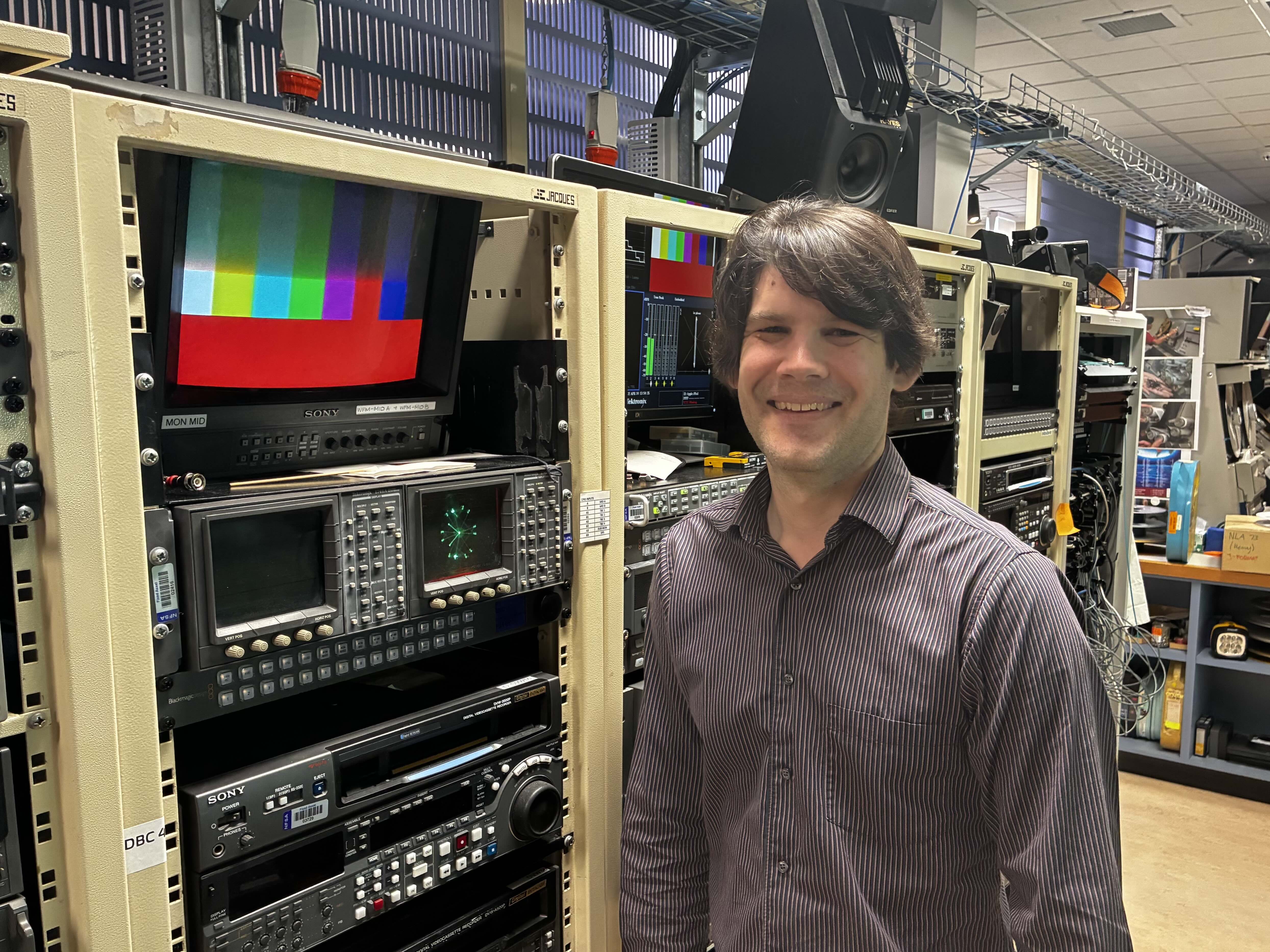
One major concern for Andrew and the archive is the impending loss of magnetic media. The NFSA’s Deadline 2025 report explains that the disappearance of essential expertise and technology will soon compromise digitisation efforts and render tape-based media unplayable.
The archive’s role in preserving history is evident when you consider the record button has existed for all of Australia’s modern history. The cultural importance of this mission is certainly evident given how ubiquitous audio-visual media has become in our lives.
To learn more, I interviewed Andrew during a visit to the NFSA. We spoke about his work and the ongoing preservation efforts of the archive.

Q: How do you guys go about collecting media?
A: There’s both proactive and reactive collecting. There will be people out there who think of us and go, “Hey, would you like this thing that I’ve recorded or that I have a copy of?” and we will say yes or no.
There are also collections that we would go out to […] and say, “Hey, when you’re done with this, would you consider donating it to us and we can look after it and make sure that the world continues to be able to see it here?”
Q: Formats have changed so significantly over the past century, how would you say that’s affected your work here?
A: We have to keep changing with the times, we’ve got everything from old wax cylinders to 8K films.
We try and preserve material to the highest standard that we can from the most original material. We want to go back to the film negative if it’s film, we want to go back to the master file if it’s a digital file.
Q: You hear a lot about lost media, do you guys have any specific items that you’ve searched for?
A: On our website we actually have a list of wanted media. There’s a lot of early television, there’s a lot of lost films; about 20 years ago we did a lost film search. Just this week we got donated a film that was considered a lost film and we’re … preserving it straight away.
Q: Is there anything that you felt was unexpected when you started?
A: I thought it would be simpler to research material […] you should be able to look things up, but there’s lots of bands out there who don’t have any presence on the internet, or there’s lots of shows that just have been forgotten.
Digitisation, I thought would be simpler as well. You’re not just putting something onto a scanner or into a video deck and hitting play. If you’re scanning a film … we want to make sure that the colors are as accurate as they were at the time that they were shown in cinema; we want to get all the audio levels right.
Q: Do you face any notable challenges in your line of work?
A: We have a very notable challenge, which is videotape. I don’t know if you’ve heard the Deadline 2025 report … that basically said that all videotape will be unplayable by 2025. Of course that isn’t the case, [but] it is very close to being unplayable.
The last company in the world that could refurbish video decks that play professional formats … decided to shut down, and that meant [there was] nowhere in the world that we could get new decks or refurbish the decks.
Once the equipment died, that was it, you couldn’t play back a particular tape format. VHS is fine, there’s a million VHS decks out there, but for Betacam, for U-matic, for 1-inch, [it’s harder].
[These are] all professional formats that television stations use to play back on-air material. Those decks we couldn’t repair, so we had to collect a whole lot of decks from television stations shutting down.

Q: How does your work differ from the work of other archivists?
A: Because we’re dealing with audio-visual [archiving], it’s a little more complex than if you’re just dealing with paper-based archiving. There’s a lot more treatments that need to go into place and there’s a lot more potentially hazardous conditions that can happen from film.
If you leave it out it can get vinegar syndrome, and that means it smells like fish and chips and it can make you sick. We also deal with nitrate material, which is extremely flammable and can be hazardous.
Q: Do you encounter any challenges, or advantages, that are unique to working in Australia?
A: I think there definitely can be funding issues. We don’t get funding from commercial enterprises. There have been other institutions like the [British Film Institute who] would get a whole lot of funding from the government and that lets them do a whole lot of work.
That being said, we did get a funding boost over the last five years, and that’s drying up now.
Q: Do you see any challenges or changes that are going to shape the future of the archive?
A: Preserving film will take a long time, we expect at least another 50 to 70 years of work to preserve the films. Audio is the same, we have a lot of disc-based audio that needs work.
There’s a long line of things that will need work, and we’ll keep them in the best conditions. We keep them in vaults that are set to the best conditions for that medium.

Q: What does it look like inside an institution that has such a long outlook into the future?
A: I think it’s great being part of an institution that is thinking so far ahead and not just the next financial year. It’s very much a curator philosophy; thinking what will generations down the line think of what we’re doing.
We’re also thinking … if we’re preserving to a particular file type, “how would that look down the line?”. We’ve got to make sure that file type has every single chance that it will be able to be used in 10, 20, 30, 50 years.
Q: What would you say your work means for preserving Australia’s history?
A: I believe we’re preserving Australia’s memory. We’re also keeping history to account.
We’re not changing or altering anything that we get in so if you want to look back and say … “What was said in that speech?”, you can listen to that speech and know word for word … what the people at the time heard.
Q: Do you see the archive having any impact beyond Australia?
A: Yes, we definitely have impact on the region. Papua New Guinea, we’ve helped out their audio-visual archive; we definitely have helped out New Zealand archives.
We have a global presence in terms of research into film preservation. There’s a lot of papers that have been written by staff from the NFSA that are often referenced globally. Ray Edmondson was our first CEO, and he’s written three books that are referenced every single day by archives across the world.
Original photos by Ben Devlin