
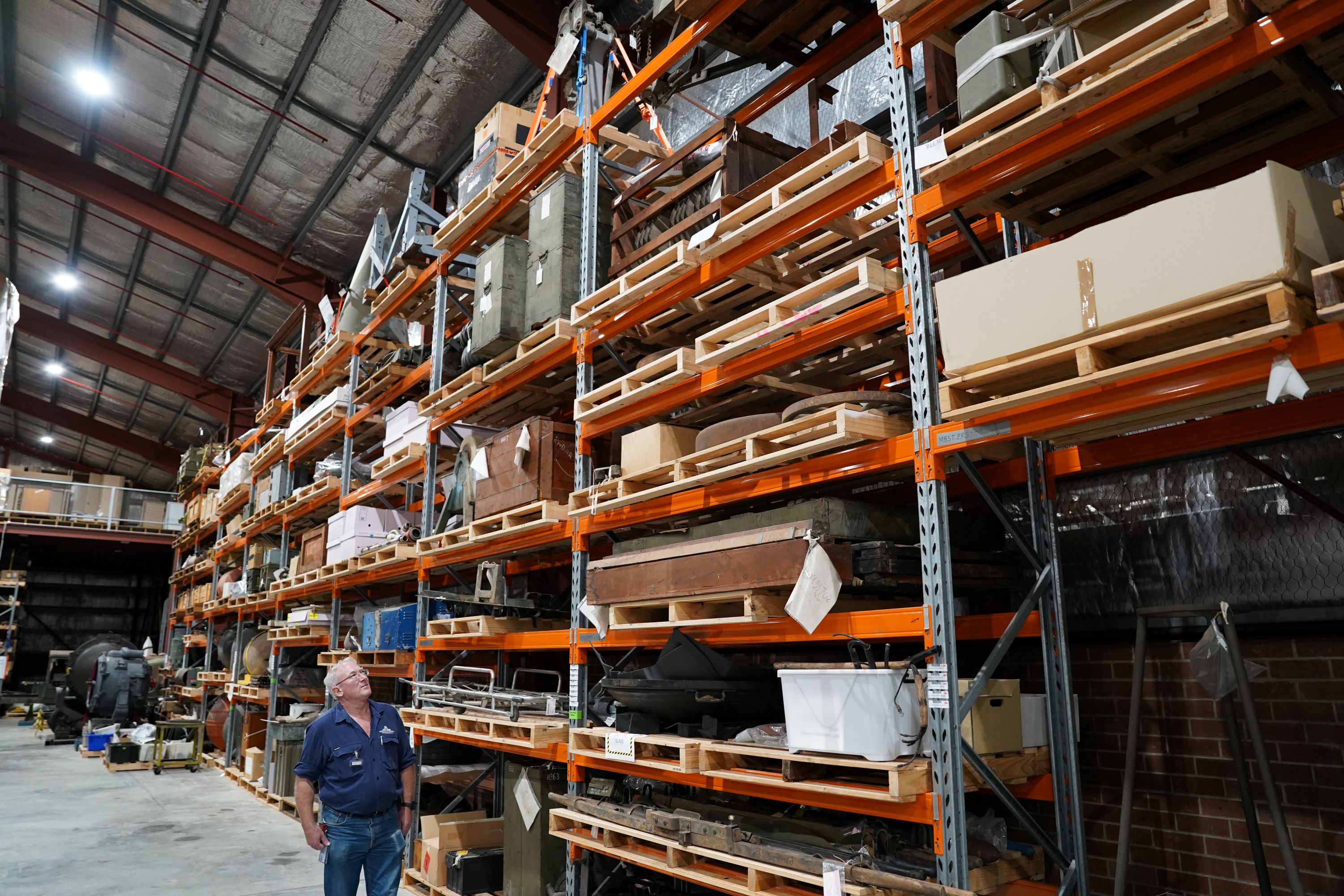
When you go to the Australian War Memorial in Canberra, you might be surprised to hear that they only have around 10 percent of their collection on display. A large chunk of the other 90 percent actually resides within the walls of the Treloar Technology Center.
The pieces stored in this facility hold stories that are powerful, emotive and yet are rarely seen by the public. Instead, they are cared for by a dedicated group of conservators and staff, who spend their careers engaging with, and maintaining these stories for the next generation.

Here is where we meet George Bailey, the Senior Conservator of Objects at the Australian War Memorial. He is going to take us on a journey through his life, work and give us a small glimpse into some of the powerful stories held within this facility.
George grew up on the outskirts of Canberra, namely the second last street in Lyneham. He has been in the Canberra community his entire life and has seen the capital expand and evolve. He spent his youth fixing bikes, running milk and toeing the line between a city and a country kid.
The son of a Second World War veteran, and a lover of aircraft, the War Memorial always seemed like a natural fit for him. To make this happen, he landed at the University of Canberra and completed a Bachelor of Applied Science, Conservation of Culture Materials. This eventually led him to the Australian War Memorial where he found a place in the Collection Services team.
George has been a conservator for over 35 years. During this time, he has worked on a wide range of projects that cover both the large and the small objects in the collection. Each piece tells its own story, and George was kind enough to share some of the stories while giving some insight into the world of conservation.

Q: I just want to talk about what were your passions when you were growing up. Were you always interested in either objects or the of discipline of conservation? Or were you heading in a much different direction as a youngster?
A: I was probably heading in a slightly different direction. My father’s a World War Two veteran, so I sort of grew up with a passion for the military and military history. I wanted to be a pilot in the Air Force, but being myopic, that was never going to happen. And when I did apply for the Air Force to try and get in a ground crew in 1982, unemployment was quite high, so every second person coming out of school was trying to get in the military for a job. So I bombed out there, I got to the third round of the selection before I got knocked out. So that wasn’t too bad. But yeah, with a passion for aircraft and military history, and growing up with the War Memorial in my backyard, I was always sort of drawn here.

Q: Can you take us through your early career at the Australian War Memorial, where did it all start?
A: I actually started here as a volunteer. I took two weeks leave from my job and came here and did two weeks solid volunteering. It was was daunting but it was also very, very interesting. That was in 1990 when I was still at university. Then a job came up, and I applied for it and I got it. So that was as an Assistant Conservator in the Objects Lab where there was three of us. So David Hallam, who’s since passed away, he was the lab head, and John Ashton, and then me.
Q: And so just for people who don’t know a whole lot around conservation, would you be able to give an explanation as to what your role encompasses as conservator?
A: So as a conservator, our role is to to try and stabilise objects so that they don’t change any further, ideally, we captured it at that moment, and it’ll stay like that for the next generation. So we stop deterioration where we can, that’s our primary goal. At the War Memorial we we have five labs. We have the Textiles Lab, the Paper Lab, the Fine Arts and Paintings Lab, Photo Film and Sound Lab, and the Objects Lab, and I guess we also have the Large Technology Workshop here. So we basically cover everything that’s not covered by those other labs. If it’s anything heavier than two people can lift, that ends up in large technology. So we have a fairly wide range of things to treat, look after.

Q: What were some of the things you remember from those early years that sort of really stuck in terms of the role you were in?
A: Mainly the way that David Hallam managed me. He encouraged me to ask questions, to think, to look at a problem and not ask, what’s the solution but also how we got to that point. Why was there a problem? What caused the problem? You know, and that’s quite important in conservation. Something’s rusty, but why is it rusty? What’s caused it to rust? And answering that sometimes influences the way you treat things and how you go about restoring it.
The Bristol Beaufort and Polly

Q: What are some of your favourite objects within the collection that you hold an affinity for?
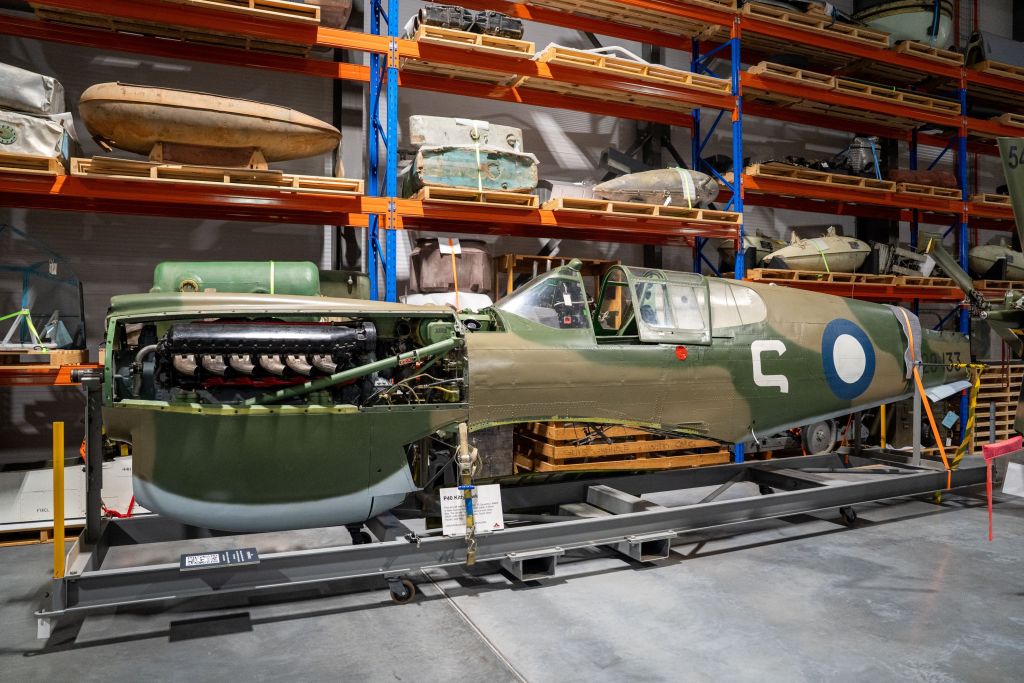
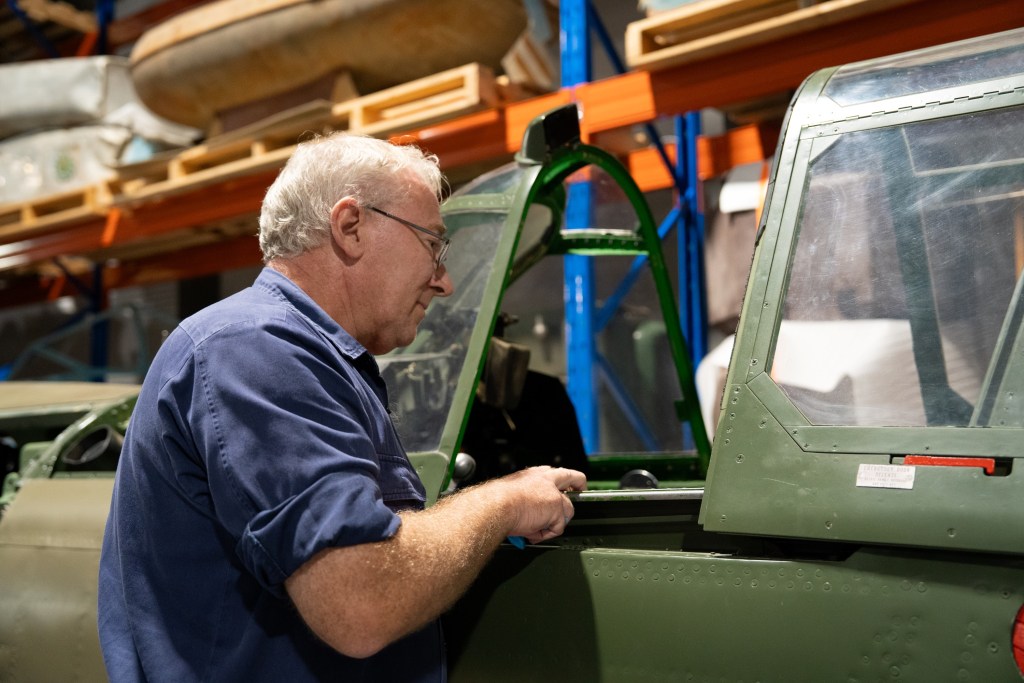
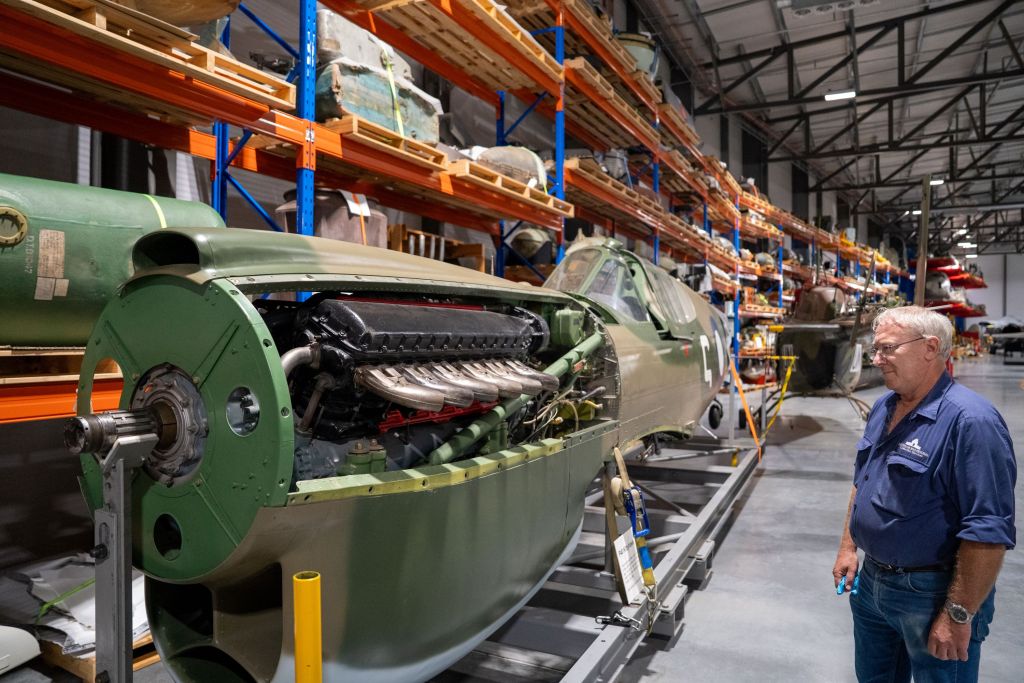
A: I have a lot of affinity towards the Bristol Beaufort, because I was in charge of the restoration of the Beaufort back in the early 2000s. While we were working on the aeroplane, I got to meet a number of veterans and hear their stories while working on that aeroplane was quite important. And same with the P 40 Kitty Hawk. That was probably the first aeroplane I worked on in any major way. I got to meet the pilot of that aeroplane, Buster Brown, and his wife, Polly, who the aeroplane is named after, which was really, really special to see how thrilled they are with the work that you’ve done.
Q: How impactful are those moments for you as a conservator?
A: Some of the most impactful moments I’ve had is meeting the veterans associated with the objects that you’ve worked on, and seeing their emotions. A lot of them are quite humbled that we think their military and service is important enough to put work and effort into. So, you know, Buster Brown was certainly one of those, he was brought to tears when he saw the aeroplane he flew in New Guinea. You know, he wasn’t an outstanding pilot, he was just your run of the mill pilot, and he was quite touched that his aeroplane was the one that was restored.

Trench Art
Q: I want to bring you back to the comment you made about stories, is that sort of the power that the objects have here at the War Memorial?
A: Certainly. One of the areas of the collections that I find really fascinating and interesting is trench art. So that’s stuff that your average run of the mill soldier, sailor or airman has made in their downtime and quite often sent that back to family and loved ones. You know, sweetheart brooches and all sorts of things like that. I find that kind of stuff really, really fascinating.


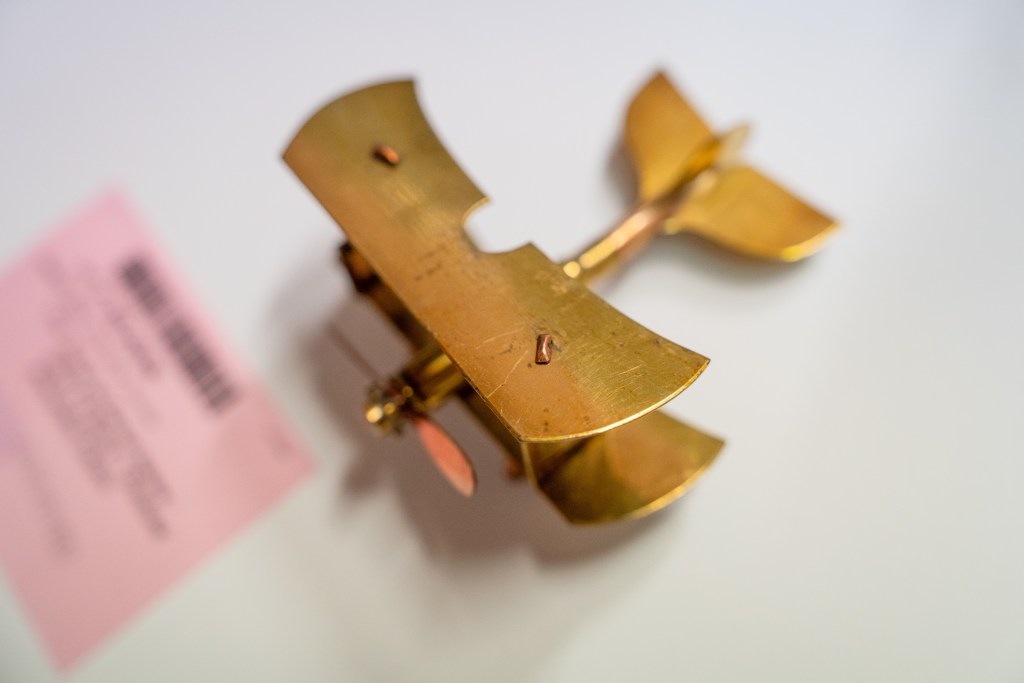
Q: It’s a side of things that I never really thought of, those personal items that people put really strong emotions into. That is actually a good way to transition into the question around what you want to accomplish in your remaining time here?
A: Most of my sort of goals have been achieved or can’t be achieved. So the V2 rocket was always one that I’d hoped was going to be restored, and we’ve done that. But I’ve always wanted to do an exhibition just on the trench art itself for its own value, disregarding politics and all that kind of stuff. But it’s just getting the message out there that, particularly in the First and Second World War, you weren’t fighting 24/7 instead you’re fighting maybe one day in a week, and the rest of the time you had to fill in time in some way or other. So it was read a book or use your hands and do something and some of our trench art is quite exquisite and quite brilliantly made. I really would like to just do an exhibition just on that kind of stuff for its own value.

Q: Trench art feels very connected to a part of history that a lot of people don’t think about: the human element. It’s those smaller moments that I think, as you’re saying, would be a really powerful exhibition to put on. And I guess one final one for you, do you have any final thoughts you’d like to add to this interview, or anything else you’d like to say that I didn’t ask?
A: Well, I’ve been working at the War Memorial for 35 years. And that’s a long time to stay in pretty much the same section because not many people do that. Part of the reason I stay is because I love the collection that we work on. As I said, I have interest in military history, my father’s legacy and what have you. But the other part is the people that I work with, like in the Collection Services section, we have 20 odd conservators and a lot of registrars and other support staff and that, and that group of people brings such a wide range of skills and backgrounds and knowledge and things like that, which I find fascinating on a daily basis. Most of the people who work here are working for the same reason I do, because they’re passionate about military history in the collection, and we never stopped learning.
Photos by Jack Golson-Lai