

Reading Outline is like flying over the coast in a helicopter, looking for the rip beneath the surface of the ocean. Something massive is moving there, but you don’t always see it at first glance.
The first time I read Rachel Cusk’s 2014 novel Outline, I was bored.
I also had this nagging feeling that I was missing something, that beyond the slow-paced plot and pages of dialogue was something very important.
So, I read it again. I paid attention this time.
If you don’t have the patience for a second read, you’re in luck. I’ve done it for you, so you get to read this review instead.
Let me introduce (or re-introduce) you to Outline‘s narrator: reader, meet Faye. She’s travelling from her home in England to teach a writing course in Athens over the summer.
Faye guides us through a meandering, sweaty collection of viscerally human encounters. Here’s a few of my favourites:

There’s the Neighbour, seated beside Faye on the plane to Athens: twice-married, twice-divorced; Ryan, whose washed-up writer status is entirely self-inflicted; Faye’s classroom of writing students, an eerie microcosmic reflection of the book itself; and Anne, through whom we get to take off the sunglasses and see Faye in broad daylight.
Anne is Faye’s reflection, her mirror image. It’s a painful, bumbling conversation. Reading this final chapter gave me a startling sense of complete understanding, similar to the comprehension of mortality you receive when you’re dumped by a wave off your boogie board aged nine.
Just me?
The back of my copy of this novel is plain; a papery cream cover with a blocky sans-serif font. It’s pretty battered now, and I’m on the verge of losing a few pages towards the end. Here’s an excerpt from the blurb:
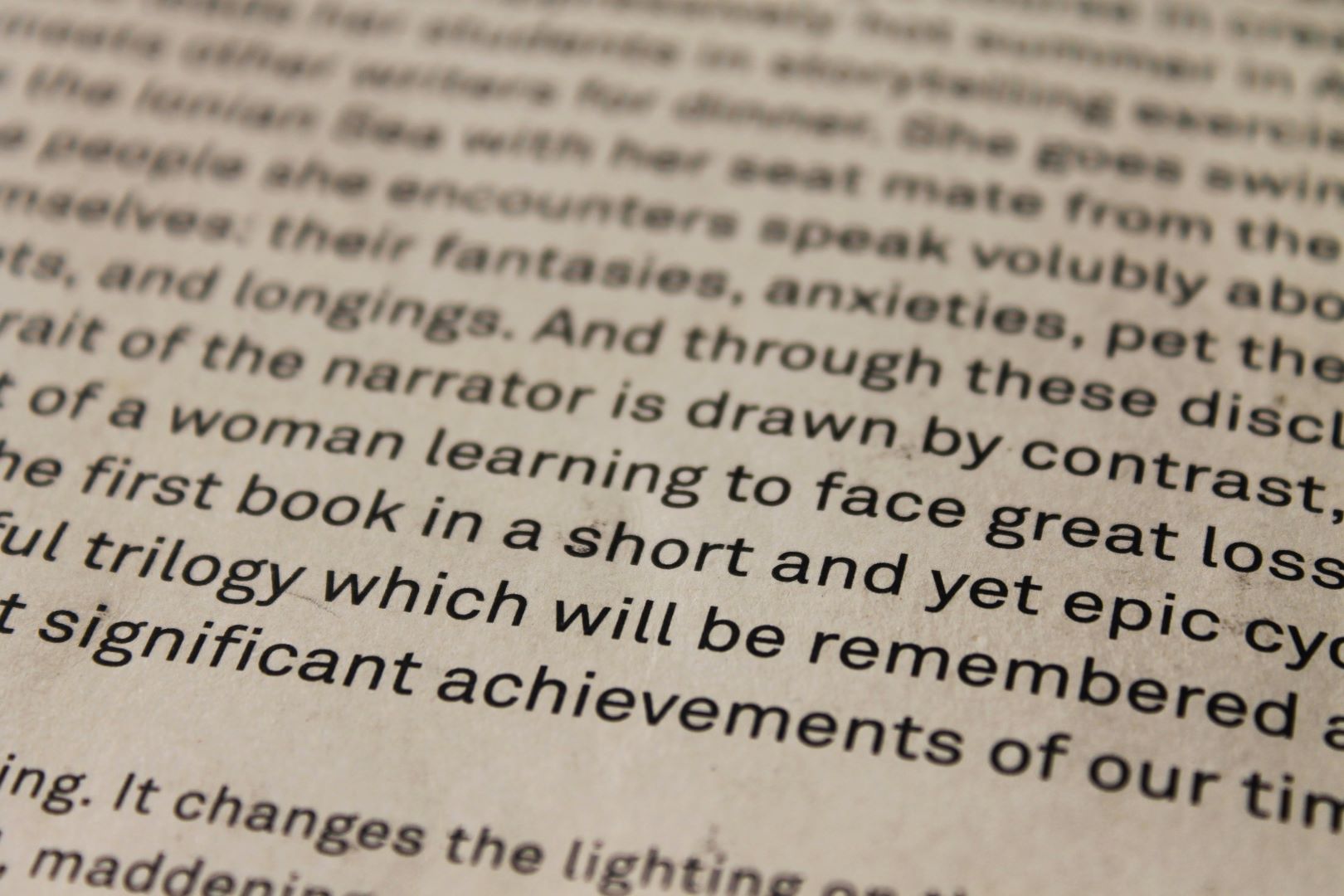
“The people [Faye] encounters speak volubly about themselves: their fantasies, anxieties, pet theories, regrets, and longings. And through these disclosures, a portrait of the narrator is drawn by contrast, a portrait of a woman learning to face great loss.”
Primarily, Outline is about ego. If you look up ‘ego definition’, one of the first results you’ll get is from the Merriam-Webster dictionary.
Faye is one of many egos—or selves—in this novel, per the first definition: “The self especially as contrasted with another self or the world.“ She is contrasted against the people she speaks to. They in turn posit themselves against the people in their lives; the Neighbour and his ex-wives, for example.
But the third definition—this is the hidden ego. This is what grabbed my attention and shook it around like an enthusiastic bartender making my Long Island Iced Tea.
“One of three divisions of the psyche…that serves as the organised conscious mediator between the person and reality.”
Faye acts as mediator between us and her reality. She gives us little hints about her hidden loss, working through other people to express her grief.
It’s important for you to know this: Faye is self-aware. She knows you’re there, reading her words. She desperately wants you to forget she even exists; we don’t find out her name until page 211, when she answers a phone call.
And still, it’s not Faye who introduces herself in this call. The woman on the other end asks for her by name.
Faye is trying to deceive you, pretending she’s there to divulge the inner lives of other people. She’s scared you’ll see the vulnerable parts of her. If you look closely, it doesn’t work. The hurt slips through.
It’s wonderful, gripping writing when you know this—Cusk is to be commended for it.
I also found it a hair-raising, eerie experience. Done well, breaking the fourth wall is about as creepy as it gets for me; take that scene in Fleabag where the Hot Priest looks into the camera. Spooky beyond belief.
So, this is Faye: the narrative ego attempting to mediate between you and her reality. She’s an unreliable, fourth-wall-smashing narrator.
The most prominent example of this mediation is her use of speech.
We most often see direct speech in fiction: “I’m saying something,” someone says.
Indirect speech and free indirect speech don’t use quotation marks. Here’s a passage from Outline where Faye is talking to the Neighbour on a boat:
“I asked whether this was the same son his second wife had locked in the cellar, and he said that it was. He had been a sweet child, but then he had gone to university, in England as it happened, and had developed something of a drug habit. He left without completing his degree and came drifting back to Greece, where various attempts were made to find employment for him.”
The first sentence here is indirect speech. The speech is attributed, but without quotation marks, we can’t know for certain that these are the exact words Faye and the Neighbour used.
Free indirect speech in the second sentence doesn’t even contain attribution.
While it’s easy to read this and assume Faye is reporting exactly what the Neighbour said, this is unreliable narration at its finest, most tricky moment.
You might be able to tell that not knowing what’s going on in a novel really tickles my fancy. It’s like a cryptic crossword, but less frustrating.

Faye chooses not to use direct speech, and this reveals her desire for control over the narrative she presents to us—remember, she knows we’re reading her writing.
This is where Faye’s power as the narrator slips away. When we understand that this novel is truly about her, the narrative ego—that mediator between person and reality—dies.
It’s both thrilling and uncomfortable to keep reading beyond the moment of understanding.
For us, as readers, it’s a complete shift in power. Suddenly, we are looking in on Faye’s inner world, seeing more than what she wants us to see. Reading it, I felt like I was an intruder in Faye’s life, like she was a real person I was spying on.
If you haven’t read Outline, go look for it in your local library. You might find your own fears between the pages.
If you have, read it again. Look beyond the waves, towards the raging current underneath.
